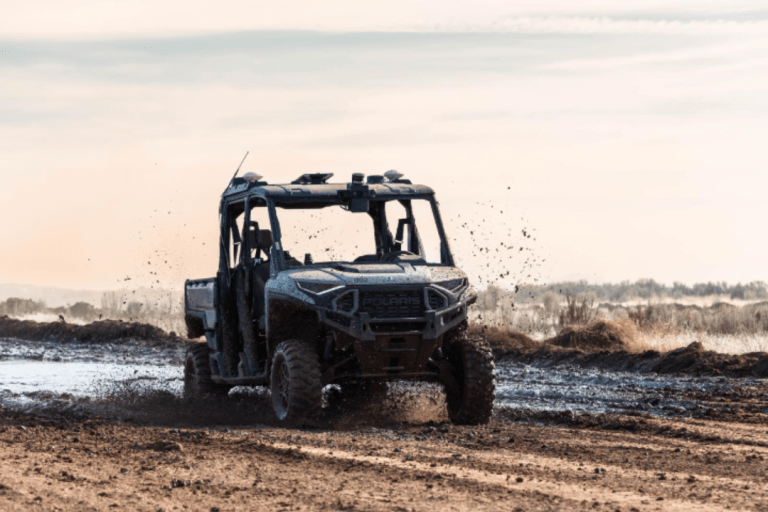
On a muddy frontline in eastern Ukraine, a new kind of American hardware is being tested under fire: more than 100 autonomous ground vehicles built by US company Forterra, quietly hauling ammunition, food and wounded soldiers through some of the most surveilled terrain on Earth.
Forterra’s Lancer vehicles, based on rugged Polaris all-terrain platforms, form what the company believes is the largest deployment of US-made autonomous ground systems in combat. Gas-powered and heavily modified with sensors, onboard computing and satellite communications, each Lancer can carry roughly three times the load of many Ukrainian-built uncrewed ground vehicles, making it a workhorse for frontline logistics.
The vehicles are a response to a battlefield transformed by drones. Persistent aerial surveillance and first-person-view kamikaze drones have turned open ground into lethal exposure. Moving supplies by manned truck or on foot now means gambling with artillery, loitering munitions and quadcopters dropping grenades. Ground autonomy offers a way to push essential cargo forward while keeping human drivers farther from the line of fire.
Ukrainian units initially viewed Forterra’s systems with skepticism, wary of Western tech that looked tailored to US doctrine rather than their own brutal realities. That changed as the Lancers were adapted in the field, including the addition of Starlink terminals for resilient communications. Soldiers who once doubted the machines now describe them as indispensable, crediting them with hundreds of resupply runs and dozens of casualty evacuations.
Yet the deployment has also exposed the limits of current autonomy. In contested zones, most Lancers are teleoperated rather than left to drive themselves. The vehicles can navigate complex terrain, but they cannot yet reliably detect and react to sudden enemy threats, from ambushes to shifting artillery patterns. Ukrainian operators are reluctant to trust full autonomy with assets that are both scarce and expensive.
For Forterra, the war has become a live laboratory. Engineers are learning how their systems cope with electronic warfare, deep mud, ad hoc repairs and software updates pushed into an active combat zone. Those lessons are feeding into efforts to blend classical robotics with newer artificial intelligence techniques, with the goal of vehicles that can reason more flexibly about danger, obstacles and mission priorities.
On a battlefield defined by attrition, cost is emerging as the next frontier. Ukrainian commanders want more Lancers, but cheap enough to risk losing. Until then, every mission is a trade-off between preserving machines and protecting the people they are slowly beginning to replace at the front.