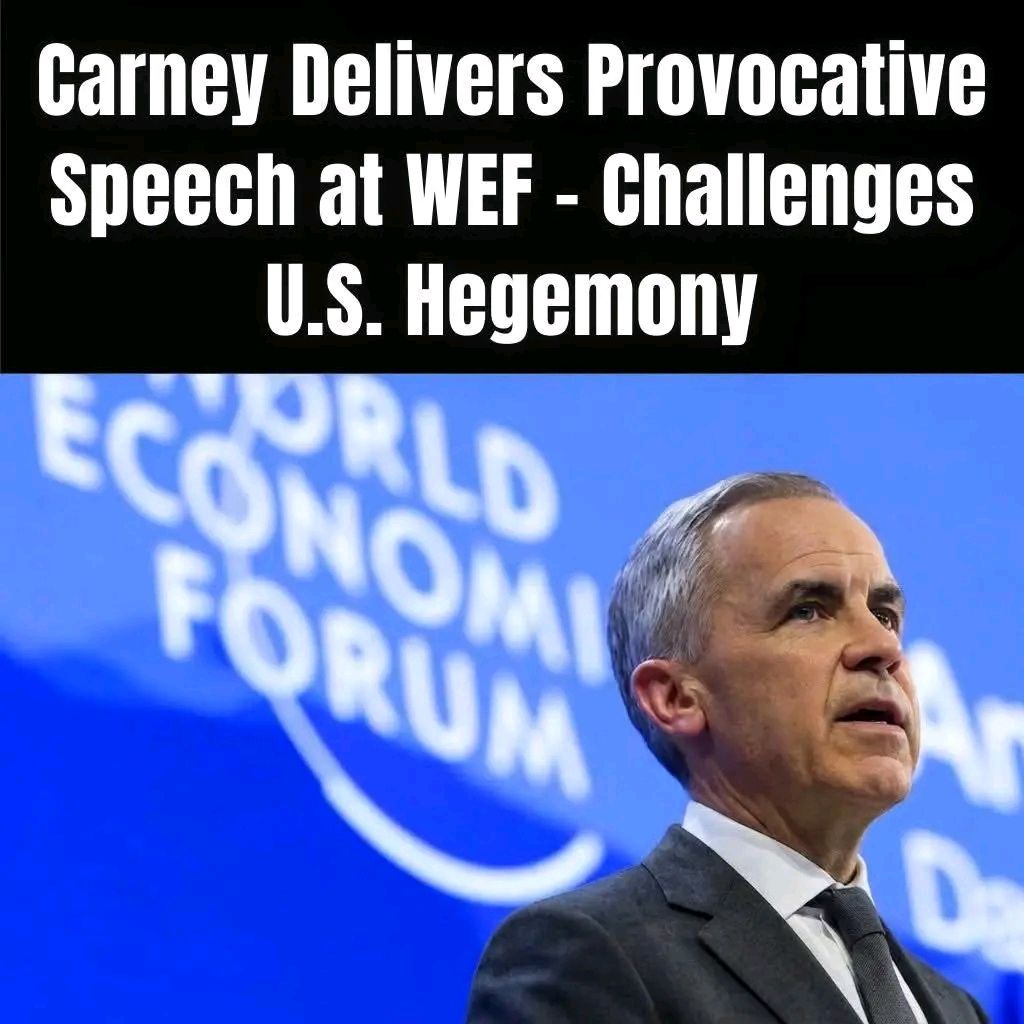
For months, the world watched Western leaders do something quietly humiliating: they smiled through insults. They absorbed taunts. They insisted, against all visible evidence, that the Western alliance was solid—even as the United States treated its supposed partners like inconveniences. Everyone could see what was happening. No one wanted to say it.
At Davos, Mark Carney finally did.
His speech was not shocking because it revealed hidden truths, but because it shattered a collective lie. He said out loud what had become increasingly obvious: under Donald Trump, the United States has stopped behaving like the anchor of the Western order and has become an unpredictable, often hostile force within it. In one moment, the performance ended. The emperor had been named naked.
Carney did not merely criticize Washington. He refused to participate in the charade that had kept Western leaders nodding along while reality drifted further away from their talking points. Standing before the world’s political and economic elite, he chose clarity over comfort—and in doing so, exposed how fragile the illusion had become.
But this was never really about Trump. Nor was it about embarrassing the United States. The real audience was Canada’s peers: democratic middle powers that have been nervously clinging to the old language of unity long after it stopped making sense. Carney was daring them to continue pretending now that the pretence had been publicly broken.
Leadership, however, is not created by speaking first. As Derek Sivers’ “first follower” idea reminds us, movements begin when someone else joins in. The first follower transforms an individual act into collective possibility. Carney has taken the risk. The world is now watching to see who follows—and who keeps the faded sign of a broken order hanging in their shop window.
For many Western observers, the moment felt historic. There is something emotionally satisfying about seeing a middle power finally push back against a bully that has crossed the line. It evokes familiar stories of smaller European states eventually standing up to Napoleon. But outside the Western bubble, there was little revelation in Carney’s words.
Carney has not discovered realism because the world suddenly became cruel. He has discovered it because the West now feels exposed. His realist reading of American behaviour is not a moral awakening; it is a strategic response to changing power realities. As America’s closest neighbour, Canada would be among the first casualties if the system continues to unravel. From that standpoint, his concern is self-interested—and entirely rational.
The “rupture” Carney describes is not new. It has always been there. Long before international relations theory, Thucydides captured the logic of global politics in a single line: the strong do what they can, and the weak suffer what they must. This is the foundation of classical realism, and it never went away.
For much of the world, the so-called rules-based order was never a comforting fiction. Iraq and Libya did not experience it as stability; they experienced selective legality enforced by overwhelming force. Serbia, Afghanistan, Syria, Yemen, and Palestine learned the same lesson. Rules did not restrain power. Power decided when rules applied.
Western governments were often silent when sovereignty was violated elsewhere, when sanctions were weaponised, or when international institutions failed to protect weaker states. What Carney now calls a rupture was, for many countries, simply the system working as designed—hegemonic discretion dressed up as universal principle.
Canada’s shock is understandable. As Carney admitted, his country benefited from the post-1945 order. As a middle power embedded in Western alliances and shielded by American dominance, Canada enjoyed security, access, and moral influence at relatively low cost. The fiction worked because it was never tested against Canada’s survival. The sign in the window did not endanger the shopkeeper.
This is the real shift. The world is not abandoning a rules-based order. The West is. What Carney presents as a global awakening is, in truth, a Western reckoning with a condition that non-Western states have long lived with. The shock lies not in the collapse of norms, but in the spread of power that now limits Western freedom of action.
It is bold for America’s closest neighbour to call for collective resistance. But this is not humanitarian idealism; it is self-preservation. Western middle powers are discovering that they no longer stand above the anarchic system—they are now fully inside it.
“The rules-based order has not suddenly failed the world. It has simply begun to fail those who once benefited most from it.”