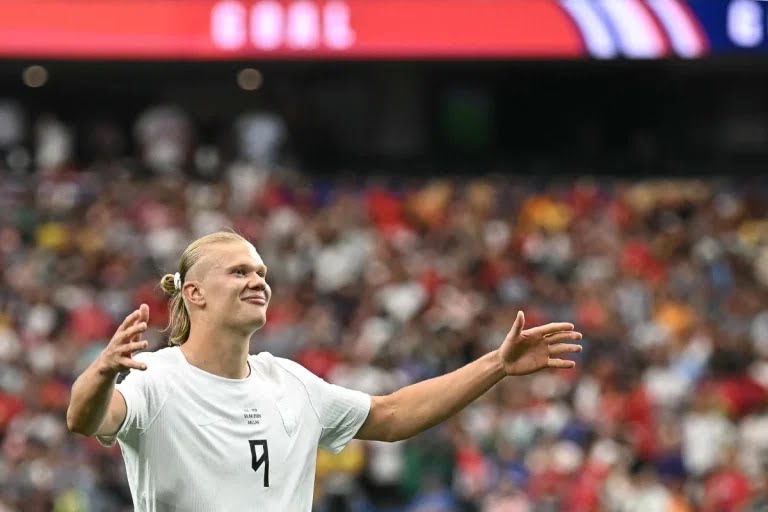
Erling Haaland has terrorised defences all tournament, and now an entire nation is banking on his ruthless finishing to carry Norway past Brazil in the World Cup last 16.
The Manchester City striker’s late winner against Ivory Coast, his fifth goal of the competition, did more than settle a tense round-of-32 tie in Arlington. It delivered Norway’s first-ever victory in a World Cup knockout match and underlined how dramatically the team has evolved since its last appearance on this stage nearly three decades ago.
Norway’s reward is a meeting with five-time champions Brazil, a fixture that instantly revives memories of their famous 2-1 comeback win in the 1998 group stage. Remarkably, the Norwegians have never lost to the South Americans, boasting two wins and two draws from four encounters.
Coach Stale Solbakken, a midfielder in that 1998 squad, is under no illusions about the scale of the task but insists his side are not in awe of the occasion.
“Brazil are favourites, of course they are, but we are hopeful that we will give them a match, and we are not playing the game for fun – we are playing to win the game and to reach the quarter-finals,” he said. “It’s possible, but it’s very difficult.”
Solbakken’s confidence rests heavily on Haaland, whom he calls “the greatest goalscorer in the world.” Haaland has scored in 13 consecutive competitive internationals, amassing 25 goals in that span and transforming Norway from plucky outsiders into a genuine threat.
“It’s amazing to have him in the team, we’re lucky to have him and it’s just about giving him as many opportunities as possible,” said captain Martin Odegaard, whose creativity from midfield has been central to Norway’s attacking fluency.
Brazil, though, possess a devastating weapon of their own in Vinicius Junior. The Real Madrid forward has four goals at this World Cup and became the first Brazilian since Ronaldo and Rivaldo to score in all three group matches, evoking memories of the country’s last title-winning campaign.
Norway goalkeeper Orjan Nyland, hardened by seasons in La Liga, insists his side will not be overawed by Brazil’s star power. Pointing to a strong qualifying run and their resilience so far, he argued that Norway’s physical presence and aerial strength give them a realistic chance.
“Because of what we’ve done over the last two or three years and what we’ve achieved so far… we know we can stop anyone,” the 35-year-old said.
Brazil, guided by Carlo Ancelotti’s vast experience, arrive with their own questions. They needed a stoppage-time winner from Gabriel Martinelli to edge past Japan in the previous round, their first comeback win in a World Cup knockout match since 2002. That narrow escape has sharpened focus on their vulnerability against European opposition, having failed to beat a European side in the knockout phase at each of the last five tournaments.
“Ancelotti is a surreal guy,” Martinelli said, describing the calm half-time team talk that preceded Brazil’s turnaround against Japan. The Italian’s composure, he added, “relaxed us” and convinced the players the game could still be won.
Brazil will be without midfielder Lucas Paqueta due to a hamstring injury, though winger Raphinha is pushing to return after a thigh problem. Even so, forward Matheus Cunha warned against reducing Norway to a one-man threat.
“I think we have to concentrate not only on him, but on several Norway players,” the Manchester United attacker said. “They have a very strong physical presence throughout the team.”
For all the tactical subplots, the narrative is clear. On one side, a traditional powerhouse seeking to reclaim its aura. On the other, an ambitious outsider led by the most feared striker in world football. If Norway are to extend their improbable run, it will almost certainly be Haaland who has the final word.