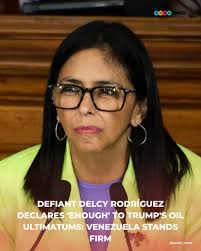
Venezuela’s interim president Delcy Rodríguez has declared that the country will no longer accept what she described as political “orders” from Washington, using a meeting with oil workers to signal a sharper break with United States influence.
Addressing employees in the oil-rich state of Anzoátegui, Rodríguez framed the struggle over Venezuela’s future as a battle for sovereignty, both political and economic. She said the South American nation had come under intense pressure to open its vast petroleum sector to US investment following the capture of former president Nicolás Maduro by US authorities, a move that has upended the country’s already volatile power balance.
Rodríguez urged Venezuelans to reclaim decision-making from foreign capitals and to channel internal disputes through national institutions rather than external mediation. “It is important that we open spaces for democratic dissent, but that it be politics, with a capital P and with a V for Venezuela,” she told the workers, insisting that domestic actors must be the ones to resolve the country’s deep political rifts.
“Enough of Washington’s orders to politicians in Venezuela. May Venezuelan politics be the one to resolve our differences and our internal conflicts. Enough of foreign powers, this Republic has paid a very high price for having to face the consequences of fascism and extremism in our country,” she said, linking foreign pressure to years of confrontation, sanctions and institutional crisis.
Her remarks came as the new authorities face mounting demands over the fate of hundreds of detainees still held in Venezuelan prisons. Families of prisoners, along with human rights organisations, have pressed the interim government to clarify who is being freed and who remains behind bars, amid longstanding allegations of politically motivated detentions.
Following Maduro’s capture, officials pledged to release what they called “a significant number” of prisoners. Rights groups say many of those detained were targeted for their political views or activism, and have urged transparent, independently verified releases.
Rodríguez said that 626 people have already been released, accusing unnamed sectors of “manipulating the figures through lies.” To address the controversy, she announced plans to ask the UN High Commissioner for Human Rights to verify the lists of those freed and those still in custody, in an attempt to close the gap between official claims and civil society reports.