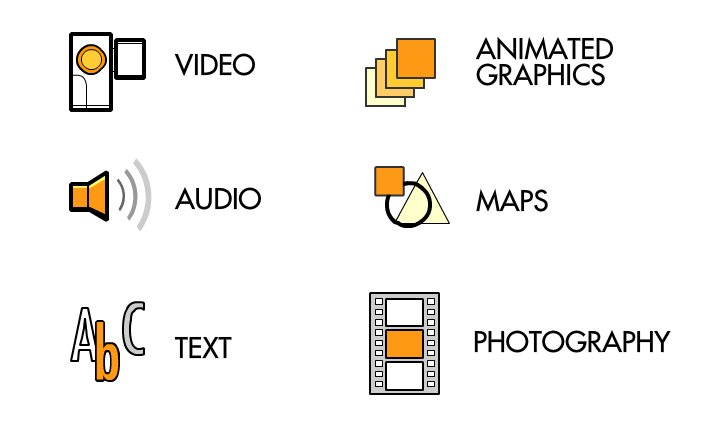
Multimedia storytelling is a structured approach to communicating information by combining different media forms, including written text, photographs, audio, video, graphics, animation, and interactive features. Its purpose is not simply to place different media elements together but to organise them so that each contributes to the development and understanding of a central story. Gitner (2022) describes multimedia storytelling as an approach that combines contemporary multimedia technology with established storytelling concepts and applies them across multiple platforms.
A key feature of multimedia storytelling is the relationship between narrative and media. Van Krieken (2018), in examining The New York Times multimedia story "Snow Fall", explains how text, images, video, audio, and graphic animation can perform different narrative functions while working together to create an immersive experience. Text can provide narrative structure and context, while images, video, audio, and graphics can provide additional ways of presenting events and perspectives. This shows that effective multimedia storytelling depends on the purposeful integration of media elements rather than simply using many formats.
Multimedia storytelling also requires both narrative and technical skills. Gitner (2022) discusses areas such as visual communication, screenwriting, website optimisation, social media, and other forms of multimedia production. These areas demonstrate that a multimedia storyteller must understand both how to develop a story and how to select appropriate media for communicating it. The storyteller must consider the information being presented, the intended audience, and the platform through which the story will be distributed.
The educational application of multimedia storytelling further demonstrates its usefulness. Tsou, Wang, and Tzeng (2006) developed a multimedia storytelling website containing story-composing and story-replaying functions for foreign language learning. The website was implemented in an elementary school to examine its usefulness in teaching and student learning. Their findings supported the educational value of the multimedia storytelling website and showed how digital storytelling can be integrated into language education.
Multimedia storytelling can also influence how people's experiences are represented. Rice and Mündel (2018) examine a multimedia story-making methodology that brings majority and minoritized creators together to represent experiences that have received limited attention. Their study focuses on experiences that may be marginalised or misrepresented within dominant cultural narratives. This demonstrates that multimedia storytelling can serve not only as a means of communication but also as a method for representing experiences and encouraging audiences to reconsider established understandings.
The effectiveness of multimedia storytelling, therefore, depends on careful planning and responsible selection of media. Each component should have a clear purpose and contribute to the central narrative. Storytellers must also consider accuracy, context, audience, accessibility, and ethical representation when producing and distributing multimedia content.
In conclusion, multimedia storytelling is a purposeful communication practice that combines narrative principles with multiple media formats. The materials provided demonstrate its relevance to journalism, digital communication, education, and the representation of diverse experiences. Its effectiveness depends on the meaningful relationship between its different components, as well as the storyteller's ability to make appropriate narrative, technical, and ethical decisions.
References:
Gitner, S. (2022). Multimedia storytelling for digital communicators in a multiplatform world (2nd ed.). Routledge.
Rice, C., & Mündel, I. (2018). Story-making as methodology: Disrupting dominant stories through multimedia storytelling. Canadian Review of Sociology, 55 (2), 211–231.
Tsou, W. L., Wang, W., & Tzeng, Y. (2006). Applying a multimedia storytelling website in foreign language learning. Computers & Education, 47(1), 17–28.
Van Krieken, K. (2018). Multimedia storytelling in journalism: Exploring narrative techniques in Snow Fall. Information, 9(5), 123.
2