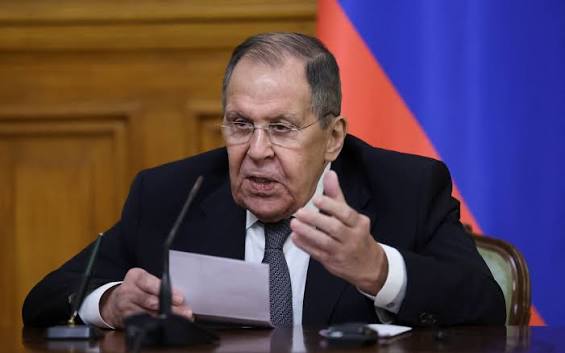
Russia’s foreign minister, Sergei Lavrov, stated that recent US and Israeli military strikes on Iran could increase the likelihood of nuclear proliferation in the Middle East. He argued that these actions may alter regional threat perceptions and security calculations among states that currently do not possess nuclear weapons.
At a press conference in Moscow, Lavrov asserted that attacks on a non-nuclear-armed state signal to other governments that the absence of a nuclear deterrent may leave them exposed to pre-emptive or punitive strikes by militarily superior powers. According to his reasoning, this could incentivize some states to consider pursuing nuclear capabilities as a means of deterrence.
Lavrov contended that, rather than strengthening the global non-proliferation framework, the strikes could lead Iran and neighboring Arab states to reassess the strategic value of nuclear weapons. In his view, such a shift would run counter to longstanding international efforts to limit the number of nuclear-armed states.
He also disputed the core rationale often cited by the United States and its allies for exerting pressure on Tehran, namely that Iran has been covertly seeking a nuclear weapons capability. Lavrov claimed that international inspectors and some US intelligence assessments have not produced conclusive evidence that Iran has manufactured or attempted to manufacture nuclear weapons.
Lavrov aligned himself with Iran’s official position that its nuclear program is focused on civilian applications, including power generation and medical uses. He emphasized that the right to enrich uranium for peaceful purposes is recognized under international law for signatories to the Nuclear Non-Proliferation Treaty, and questioned the logic of requiring Iran alone to relinquish a capability that other states are allowed to maintain.
He argued that demanding unique restrictions on Iran could be viewed as a double standard, which in turn may weaken confidence in international institutions and generate political resentment, particularly among developing countries.
Russia maintains a close partnership with Iran and has characterized the strikes as destabilizing for regional security. The Kremlin has warned that continued military escalation could broaden the conflict. President Vladimir Putin has publicly condemned the killing of Iran’s Supreme Leader Ayatollah Ali Khamenei and called for an immediate cessation of hostilities, framing Russia’s position as support for state sovereignty and opposition to what it describes as excessive use of force by Western powers.