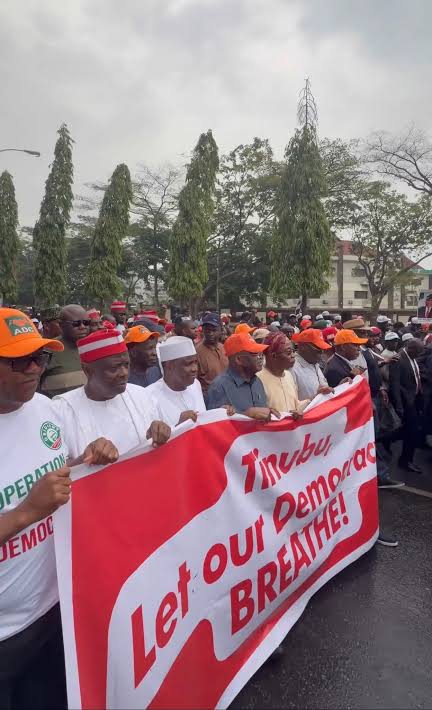
Abuja’s much-hyped anti-INEC protest, led by the African Democratic Congress ADC and a handful of opposition figures, has ended in an embarrassing whimper, drawing sharp ridicule from activist-lawyer Deji Adeyanju, who is openly questioning whether Nigeria’s opposition still has any real fight left in it.
The ADC had loudly advertised the Abuja action as a major showdown with the Independent National Electoral Commission and its chairman, promising a decisive push over alleged electoral irregularities and a supposedly compromised umpire. But after all the noise and posturing, the protest barely lasted three days before evaporating without a single concrete concession, resolution or sustained public pressure.
Adeyanju, known for his own long-running street actions, wasted no time in tearing into the organisers, portraying the ADC-led move as a shallow, media-chasing stunt rather than a serious political intervention. For him, the rapid collapse of the protest is proof that today’s opposition is big on press conferences and hashtags, but short on stamina, conviction and basic organisational capacity.
He openly contrasted the ADC’s three-day drama with earlier waves of activism that actually shook the system, pointing to the #ResumeOrResign campaign under former President Muhammadu Buhari. Back then, a small but determined group of protesters managed to dominate national discourse for weeks, demanding clarity on Buhari’s health and fitness to govern, even in the face of alleged pro-government counter-mobs.
Adeyanju also reminded Nigerians of his own 109-day sit-out at Abuja’s Unity Fountain over the killing of members of the Islamic Movement in Nigeria, holding it up as the benchmark for what real, issue-driven activism looks like. Against that backdrop, he paints today’s opposition leaders including those eyeing President Bola Tinubu’s seat as lightweight contenders who cannot even sustain a protest beyond a long weekend.
In Adeyanju’s telling, the aborted anti-INEC march is not just a failed outing; it is a symbol of a wider decay. Activism and opposition politics, he argues, have been downgraded to brief, camera-ready spectacles that generate headlines but no hard results and no lasting citizen mobilisation. His mockery of the ADC leadership is therefore a broader indictment: a blunt claim that Nigeria’s so-called resistance has become hollow, performative and fundamentally unserious.