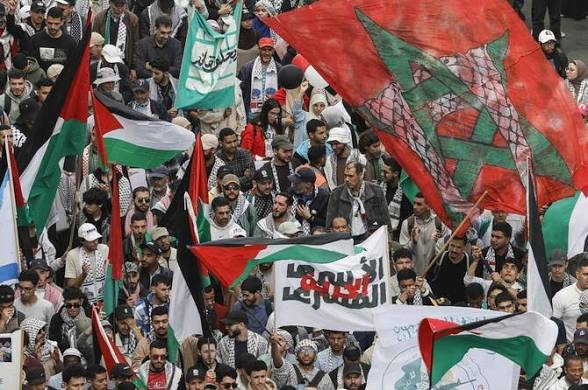
Thousands of Moroccans filled the streets of central Rabat, marching along Mohammed V Avenue to denounce a new Israeli law that paves the way for executing Palestinians convicted of deadly attacks. The demonstrators framed their protest as both a rejection of capital punishment and a renewed declaration of solidarity with the Palestinian people.
Organized by the National Action Group for Palestine, a coalition that unites Islamist movements, left-wing parties and civil society organizations, the march drew an estimated 5,000 people. Many carried Palestinian and Moroccan flags, while others held placards depicting prisoners and victims of the conflict in Gaza.
Chants echoed through the avenue, condemning the death penalty and Israel’s military operations, and calling for justice for Palestinians living under occupation. Protesters described their presence as a moral obligation in the face of what they see as an escalation of punitive measures targeting Palestinians.
The contested Israeli legislation would make the death penalty the default punishment for Palestinians in the occupied West Bank convicted in military courts of attacks classified as terrorism that result in deaths. It would also expand the possibility of capital punishment in certain civilian court cases, a move critics say entrenches a discriminatory system.
Human rights organizations and legal experts have warned that the law risks formalizing a dual legal regime, one for Israelis and another for Palestinians, and could violate international human rights standards as well as Israel’s own constitutional principles. Palestinian officials have condemned the measure as a tool of political repression rather than justice.
In Rabat, speakers addressing the crowd argued that the law is part of a broader pattern of collective punishment and dehumanization. Religious leaders and legal advocates took turns at makeshift podiums, insisting that the death penalty contradicts both humanitarian norms and the spirit of many religious teachings.
The march also revived domestic debate over Morocco’s normalization of relations with Israel. Many demonstrators demanded that Rabat reassess or suspend its ties, insisting that continued diplomatic engagement sends the wrong signal while the war in Gaza and new punitive laws proceed unchecked.
For many in the crowd, the protest was as much about Morocco’s conscience as it was about events abroad, a public attempt to align national policy with the strong pro-Palestinian sentiment that has long run through Moroccan society.