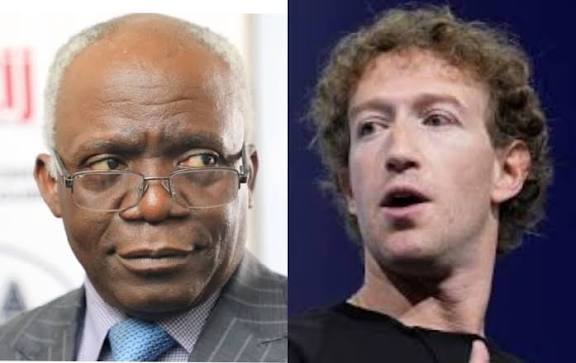
The Lagos High Court, TBS division, has ordered Meta Platforms Inc. to pay 25,000 dollars in damages to Nigerian lawyer and human rights advocate Femi Falana SAN, after finding that the company violated his privacy and mishandled his personal data.
The dispute arose from a video circulated on Facebook under the name “AfriCare Health Centre,” which falsely suggested that Falana was suffering from prostatitis. The video used motion images and voice captions to present the alleged condition as fact. Falana denied the claim and asserted that the publication was false, invasive and damaging to his reputation.
Falana sought 5 million dollars in damages, arguing that Meta allowed the false content to be disseminated and monetised on its platform. He claimed that the video violated his constitutional right to privacy under Section 37 of the 1999 Constitution of the Federal Republic of Nigeria (as amended) and breached Nigeria’s data protection regime by unlawfully processing sensitive health information.
Justice Olalekan Oresanya held that Meta, as a global technology company that profits from user-generated content, could not rely on the defence of being a neutral intermediary. The court found that Meta owed a duty of care to individuals whose personal data and images appear on its platforms, particularly where content is monetised and the risk of harm from misinformation is reasonably foreseeable.
The court accepted that the video constituted an invasion of privacy and unlawful processing of personal data. It identified health information as a highly sensitive category of personal data that attracts heightened legal protection. By allowing the false medical claims to be published and remain accessible, Meta was found to have intruded into Falana’s private life and exposed him to unwarranted public scrutiny.
Falana argued that the video damaged the reputation he had built over decades as a lawyer and public advocate, describing the publication as false, offensive and disturbing. The court agreed that the content was capable of lowering him in the estimation of reasonable members of society and that it lacked any lawful factual or legal basis.
Justice Oresanya rejected the proposition that public figures must accept greater intrusions into their private medical information. The court held that Falana’s public status did not remove his right to privacy regarding his health. It clarified that public prominence does not convert private medical data into material that can be freely used for speculation, commercial exploitation or misinformation.
The court examined Meta’s role in processing and disseminating the content and concluded that Meta does more than provide passive infrastructure. By designing and controlling algorithms that promote, distribute and monetise posts, Meta was found to determine the means and purposes of processing and to act as a joint data controller with the page operators who uploaded the video.
On this basis, the court held Meta vicariously liable for the publication and its consequences. It found that Meta’s control over advertising tools, content promotion and revenue-sharing mechanisms meant the company derived commercial benefit from the circulation of the false video. This commercial involvement was held to create a corresponding responsibility to prevent or promptly address harmful and inaccurate content, especially where sensitive personal data is involved.
The judgment applied Nigeria’s data protection framework, particularly the Nigeria Data Protection Act (NDPA). Justice Oresanya found that Meta breached Section 24 of the NDPA by processing personal data that was inaccurate, harmful, lacked a lawful basis and was unfair to Falana. The court treated the false health information as unlawful processing in itself, without requiring proof of additional damage beyond the established invasion of privacy and reputational harm.
The court stated that where the risk of inaccuracy is foreseeable, especially for health data, platforms such as Meta owe a heightened duty to ensure the accuracy and integrity of hosted and promoted information. It found that Meta failed to implement adequate safeguards to prevent or mitigate the harm caused by the false video. Given Meta’s technical and financial resources, the court expected effective content-review systems, rapid takedown procedures and risk-based safeguards against misinformation.
By not meeting this standard, Meta was found to have fallen short of its obligations under Nigerian law and to have engaged in regulatory non-compliance. The court awarded 25,000 dollars in damages, significantly below the 5 million dollars claimed, but characterised the award as recognition of the seriousness of the privacy violation and as a signal that digital platforms operating in Nigeria must align their practices with constitutional and data protection norms.