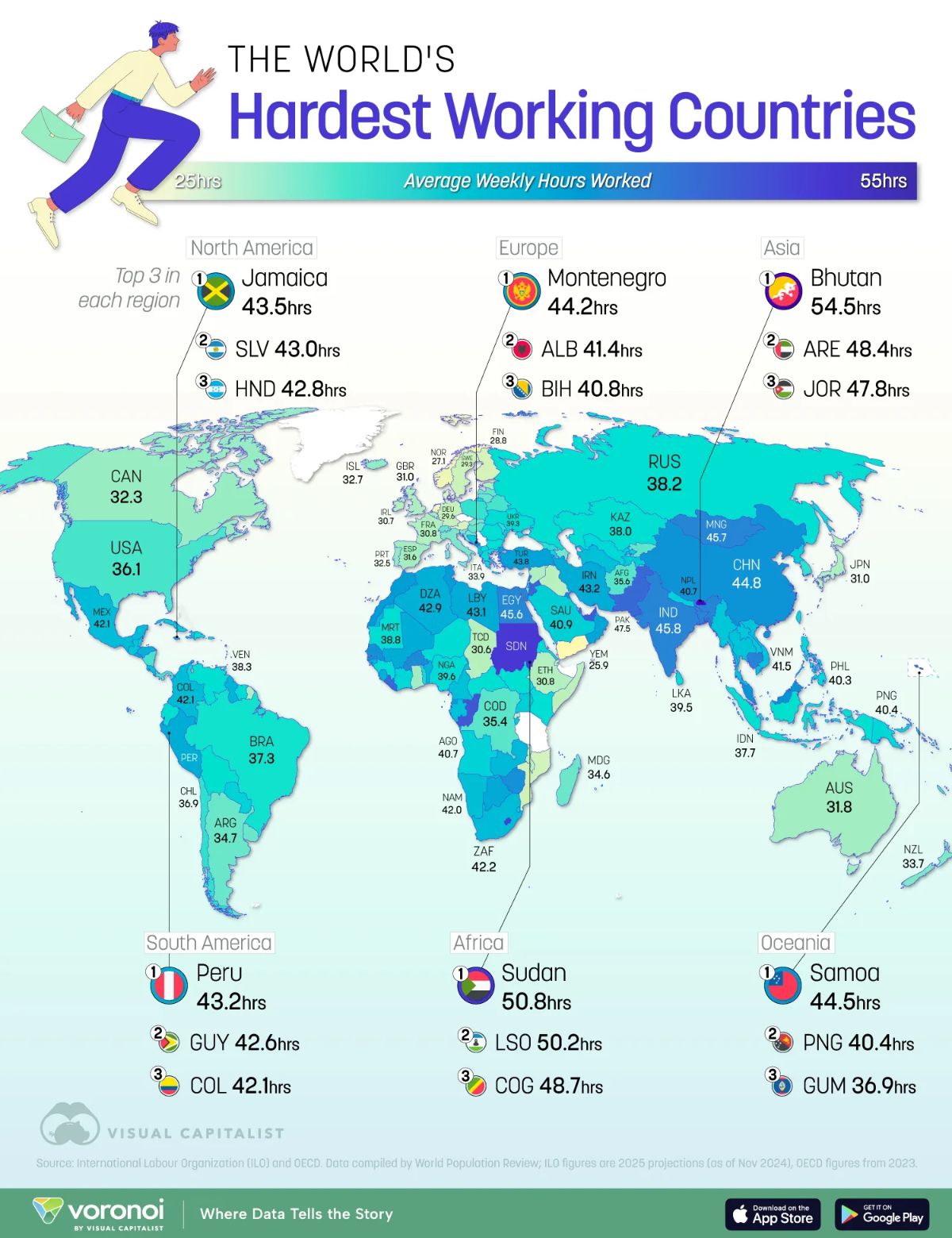
Global labour averages indicate that individuals work approximately 38.7 hours per week. However, a notable disparity exists between countries with the longest and shortest work hours, with a gap of nearly 30 hours. As of 2025, certain nations are identified as having particularly lengthy workweeks, often due to the nature of their economies, the structure of their social safety nets, and the availability of part-time employment options. The World Population Review has compiled data that provides estimates of work hours across both formal and informal sectors.
1. Bhutan – 54.5 hours
Bhutan is reported to have the highest average workweek in the world, with employees working about 54.5 hours. This trend is attributed to labour-intensive industries and a cultural emphasis on work ethic. The economy is predominantly reliant on agriculture and tourism, sectors that necessitate considerable commitment from the workforce.
2. Sudan – 50.8 hours
In Sudan, workers average just over 50 hours per week. The combination of economic pressures and a significant informal labour sector contributes to these extended hours. Political instability and limited employment opportunities force many individuals to work longer hours to support their families.
3. Lesotho – 50.2 hours
Lesotho's workforce logs more than 50 hours on average each week, largely due to the dominance of the agriculture and mining sectors, which require long hours from both formal and informal workers. The absence of strong labour regulations exacerbates this issue, leaving many with little choice but to accept longer hours.
4. Republic of the Congo – 48.7 hours
The Republic of the Congo has an average workweek approaching 49 hours. Resource-driven industries and a lack of labour protections typically lead to extended working hours. Workers face numerous challenges, including inadequate infrastructure and economic instability, which contribute to their lengthy hours.
5. United Arab Emirates – 48.4 hours
In the United Arab Emirates, particularly in urban areas, employees average 48.4 hours per week. The high-demand sectors of service and construction play a significant role in these extended hours. The rapid development of the region has resulted in a competitive job market, prompting workers to extend their hours to enhance job security.
6. Sao Tome & Principe – 48.2 hours
Workers in Sao Tome & Principe average just over 48 hours per week. The necessity of long hours is largely driven by small-scale agriculture and tourism-related jobs, both of which are critical to the country's economy. Consequently, the lack of flexible working arrangements further perpetuates this trend.
7. Jordan – 47.8 hours
In Jordan, employees work nearly 48 hours per week, influenced by both public and private sectors where long hours are prevalent due to labour-intensive services and a scarcity of part-time positions. Economic challenges and high unemployment rates compel many individuals to accept longer hours to ensure job security.
8. Liberia – 47.5 hours
Similar to Jordan, workers in Liberia average 47.5 hours weekly. The reliance on informal sectors and ongoing economic development challenges contribute to the necessity of long working hours. The aftermath of civil conflict has created precarious employment situations, resulting in a culture of overwork as individuals strive to improve their conditions.
9. Pakistan – 47.5 hours
Pakistan shares the same average of 47.5 hours per week with Liberia. The agricultural, manufacturing, and small business sectors often require employees to work extensive hours. The diverse economic landscape frequently necessitates that workers juggle multiple jobs, further extending their workweeks.
10. Qatar – 46.8 hours
Qatar ranks tenth, with workers averaging nearly 47 hours weekly. The demands of rapid urbanization and construction projects primarily explain these lengthy hours, particularly in both formal and migrant labour sectors. The influx of foreign workers in construction has created a high demand for labour, often resulting in extended work hours.
This overview illustrates how various factors, including economic structure, labour laws, and industry demands, shape working hours across different countries. It emphasizes that extended workweeks are often associated with challenging labour conditions. The data underscores the necessity for ongoing dialogue regarding workers' rights and the importance of fostering sustainable work environments that prioritize both productivity and employee well-being.
Comments expressed here do not reflect the opinions of Vanguard newspapers or any employee thereof.