The Woman Who Married the River
There is a story my grandmother told only at night, only when the rain had already started, as though the water outside gave her permission to speak of the water inside the story. I tell it now the way she told it, though some of the words are mine, worn smooth by my own hands the way a stone is worn smooth by a river that has held it too long to let it go.
Her name was Adaeze, and she was the kind of beautiful that made market women stop weighing their pepper to watch her pass. She lived at the edge of the village, where the last compound met the trees, and past the trees, if you walked long enough and did not look back, you reached the river. The old ones called it Nne Mmiri, Mother of Water, and left it offerings of white cloth and boiled yam, not because they loved it, but because they had not yet found a way to stop needing it.
Adaeze went to the river the way other girls went to church. Every evening she carried her clay pot down the narrow path, and every evening she stayed longer than the water alone required. She told her mother she liked the quiet. She did not tell her mother about the voice.
It came the first time as a ripple with no wind behind it. By the fifth time, she was answering it. He called himself nothing at first. When she pressed, he said a sound like water deciding which way to fall. She called him Kanu, the one who receives, because she needed something to hold when he was not there, which was most of the time, since he could not leave the water and she could not stay in it.
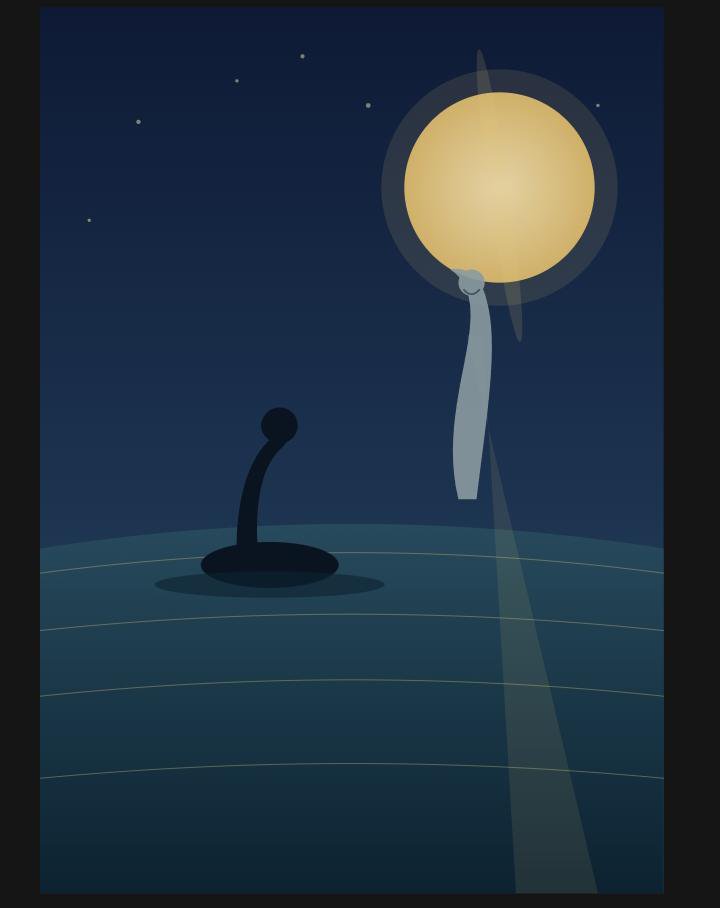
He never came fully out. He would rise from the chest upward, his lower body dissolving into current the moment she looked too closely. His skin held the color of river stones at dusk, grey going gold at the edges. She learned not to mind. Love, she found, was mostly a long negotiation with the things you decide not to mind.
For two years she went to him. She married in the eyes of the village to a farmer named Obinna, a good man who deserved a wife fully present, and she gave him that during the day, cooking his meals with real attention, laughing at his mother's jokes, carrying his children low and safe. But in the evenings, when the light went the color of over-steeped tea, her feet remembered the path to the river, and she followed it the way a person follows their own pulse.
Obinna knew. Husbands always know, even when they cannot say what it is they know. He did not ask. Some men understand that certain doors, once opened with a direct question, cannot be closed again to the same size.
The trouble began the year the rains failed. The river shrank until it was more mud than water, until the fish surfaced belly-up. Adaeze went to the bank anyway, out of habit, out of the specific loyalty a person keeps for the place where they were first loved. She called his name into water that barely covered her ankles.
He came, but smaller. His grey-gold skin had gone the color of ash left too long in rain. His voice cracked in the middle when he said her name.
I am going, he told her. Not by choice. The river carries me, and the river is leaving.
She asked where. He did not know. That was not how it worked. A spirit of water goes where the water goes, and the water answers to a logic older than wanting. She offered to go with him. He looked at her the longest he had ever allowed, and told her the truth, because he loved her enough to withhold the easier lie.
You would not survive becoming what I am. And I cannot survive becoming what you are. We were never the same kind of thing. We only met at the edge, where your kind of thing and my kind of thing happen to touch.
She did not cry in front of him. She had learned that some grief is better carried alone, the way certain water is better carried in cupped hands than in any pot, because a pot makes you believe you can keep it.
That night the rains came back all at once, violent and grateful, as though the sky had been holding its breath out of respect for a conversation it sensed was happening below it. The river rose and returned to its old banks, full and indifferent, moving the way it always moved, toward the sea, toward whatever waits after the sea.
Adaeze went down one final time and called his name into water too deep now to see through. Nothing answered but the current, and the current never sounds like any one thing. It sounds like everything that has ever fallen into it, all at once, forever.
She stood there until Obinna came looking, wrapped his cloth around her shoulders, and walked her home in a silence that was its own kind of mercy.
She lived a long life. She raised her children well. She laughed the same curling laugh at market, though something in it now had a note that had not been there before, the note a bell has after it has been cracked once and mended, still ringing, still true, but changed in a way only the closest listeners could hear.
My grandmother always ended it the same way, setting down her cup of tea as if the story needed somewhere to rest.
Every river has taken someone's love and kept it, she would say. That is not cruelty. That is simply what rivers are for. We give them our worst griefs and our best years, and they carry both to the sea without telling us the difference, because to the river, there is no difference. There is only what moves, and what is asked to let it.
I do not know if the story is true. My grandmother swore it was, the way grandmothers swear most things that need believing more than proving. But every river I have ever stood beside, I have felt the smallest, most foolish urge to say a name into it. Just to see if anything rises. Just to see if anything remembers how to answer.
7