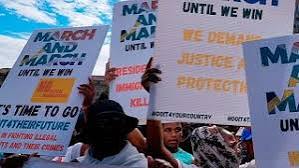
Hundreds of protesters poured into the streets of Kwa-Thema, a township southeast of Johannesburg, defying President Cyril Ramaphosa’s stern warning against vigilante action and signalling a hardening anti-migrant mood across South Africa.
Chanting and singing as they marched past rows of modest homes and spaza shops, demonstrators demanded a crackdown on undocumented foreigners and tighter border controls. Some carried sticks, others hoisted placards reading Go home, while organisers insisted the march would remain peaceful.
Lead campaigner Nkosikhona Phakel’umthakathi Ndabandaba voiced the crowd’s anger, calling for a border wall and stricter enforcement of immigration laws. His message echoed a growing movement of community-based groups that accuse migrants of taking jobs and straining public services, and that have issued their own deadlines for foreigners to leave.
The protests in Kwa-Thema are part of a wider pattern. Similar marches have been reported in the Western Cape and Limpopo, feeding fears that localised grievances are coalescing into a coordinated, xenophobic campaign. At least two Mozambican nationals have been killed in recent unrest, and several African governments have begun evacuating their citizens.
Ramaphosa, in a nationally broadcast address, acknowledged frustration over high unemployment and porous borders but drew a sharp line at vigilantism. He warned that no one is allowed to confront people in the street to demand proof of nationality and vowed to act against those exploiting public anger for political or criminal ends.
There is no space for xenophobia, racism, sexism, Afrophobia or any other forms of intolerance in South Africa, he said, framing the crisis as a direct challenge to the country’s constitutional values.
Yet protest organisers treated the speech as validation rather than a rebuke. Ndabandaba said they respected the president but would continue mobilising until authorities delivered concrete action on immigration, effectively daring the state to choose between enforcing rights and appeasing restless communities.
South Africa hosts more than three million foreign nationals, many from neighbouring countries, in an economy where unemployment exceeds 30 percent. Past waves of xenophobic violence in 2008, 2015, 2016 and 2019 left deep scars, and recent scenes of foreign families seeking refuge in churches and community halls have revived memories of those attacks.
As Ghana, Malawi, Mozambique and others organise repatriation for their citizens, regional governments are urging caution. Inside South Africa, the standoff between a rights-based constitutional order and street-level vigilantism is sharpening, with Ramaphosa’s warning so far doing little to cool the streets.