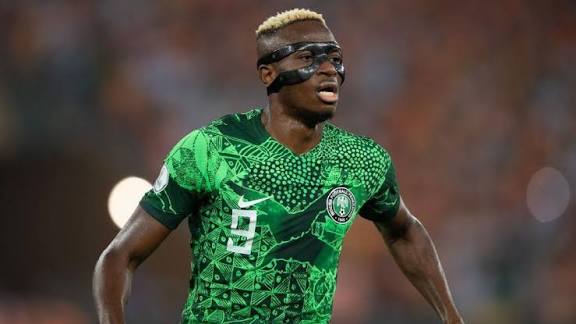
Super Eagles stars Victor Osimhen and Bright Osayi-Samuel have condemned the standard of officiating in Nigeria’s Africa Cup of Nations semifinal defeat to hosts Morocco, describing the referee’s performance as “nothing to write home about” and “appalling” after a tense, goalless encounter decided on penalties.
Nigeria’s campaign ended in heartbreak with a 4-2 loss in the shootout after 120 minutes without a goal. Yet, for many in the Nigerian camp, the story of the night was not just missed spot kicks, but a pattern of decisions they believe tilted the balance in favour of the hosts.
At the centre of the storm was Ghanaian referee Daniel Nii Laryea, whose handling of the match drew anger from Nigerian players, officials and supporters. Throughout the game, the Super Eagles appeared increasingly exasperated as a series of contentious calls went against them, feeding into a wider narrative that Morocco had benefited from favourable officiating throughout the tournament.
One of the flashpoints came in the second half when Nigerian defender Calvin Bassey was booked after a clash with Moroccan forward Diaz. Television replays suggested that Diaz had initiated contact by tugging Bassey’s shirt, before theatrically clutching his face and going to ground, even though Bassey’s hand did not appear to make contact with his head. Many observers felt that if any card was warranted, it should have been for simulation by the Moroccan forward, not a caution for the Nigerian defender.
That incident was only one in a string of decisions that left the Super Eagles feeling aggrieved. Striker Akor Adams was penalised for a foul despite seemingly having his own shirt almost torn off his back as he tried to hold up the ball. Winger Moses Simon was left baffled when what looked like a clear deflection off a Moroccan defender was awarded as a goal kick instead of a corner to Nigeria, cutting short a promising attacking opportunity.
Individually, none of these calls can be said to have definitively decided the match. Collectively, however, they contributed to a sense among Nigerian players that they were battling not only a strong Moroccan side and a partisan home crowd, but also the officials. The stop-start nature of the game, frequent whistles and perceived inconsistency in foul calls made it difficult for Nigeria to build rhythm or impose their usual high-intensity style.
Osimhen, who led the line for Nigeria and worked tirelessly throughout the contest, did not hide his frustration when he spoke afterwards. “To be honest with you, today’s game was nothing to write home about in terms of the officiating. It was that bad,” he said, his disappointment evident.
“Me and my teammates, we are all professional, but it’s disappointing. It’s hurting because now we have to wait for more years to try to qualify again for the AFCON and try to prove a point.”
Osayi-Samuel, who has grown into a key figure in Nigeria’s back line, went even further in his criticism. “The referee was appalling,” he said. “I’m not saying that’s the reason why we lost but he was making very, very wrong decisions and it’s really painful to see that we have referees like that in a game like today.”
The anger from the Nigerian camp did not arise in isolation. Throughout the tournament, murmurs had grown louder about what some perceived as a pattern of decisions favouring Morocco. From marginal offside calls to soft penalties and lenient treatment of Moroccan challenges, critics argued that the hosts were repeatedly on the right side of tight calls.
The controversy became so widespread that Morocco coach Walid Regragui was compelled to address the accusations publicly, insisting that his team were winning on merit and not because of any institutional bias. Nonetheless, the semifinal only intensified the debate, with Nigerian voices adding fresh fuel to the fire.
Former Super Eagles forward Victor Anichebe was among those who took to social media to vent his frustration at the standard of officiating across the competition. “Afcon referees are honestly ridiculous. They drive me insane,” he wrote on Instagram, while still finding room to praise Morocco’s organisation and infrastructure and to criticise what he described as Nigeria’s “incompetence” at administrative level.
“Well done to Morocco. They deserve to go through with the infrastructure and tournament they have put on. We’re lucky to get so far being led by incompetence. The boys did fantastic. It’s going to be a fantastic final,” he added, drawing a sharp contrast between the players’ efforts and the broader structures around them.
Super Falcons star Asisat Oshoala also weighed in, questioning what she portrayed as an overly cosy relationship between the Confederation of African Football and Morocco. “The big question here is when will this whole @CAF_Online compensation to Morocco end,” she posted on Twitter. “Awards, tournaments and all... it’s getting boring now. We need other countries to step up. Everything concerning African football happens in Morocco, feels like that’s the new HQ.”
For referee Laryea, the backlash was immediate and intense. Within hours of the final whistle, angry Nigerian fans had tracked down his social media accounts and flooded them with abuse. His Instagram page was taken down after a wave of reports, while his presence on other platforms was bombarded with criticism and insults, highlighting the increasingly toxic intersection between high-stakes football and online harassment.
Lost amid the controversy was the fact that Morocco had executed their game plan effectively. They succeeded in disrupting Nigeria’s flow, closing down space for Osimhen and limiting the supply from wide areas. Both sides created half-chances but neither could find a breakthrough, and for the first time in the tournament, each team was held scoreless over 120 minutes.
Osimhen, despite his anger at the officiating, acknowledged the quality of the opposition and the resilience shown by his own side. “It is one of the most difficult matches we have played at this AFCON,” he said. “When you play against this kind of quality team you have to be alert at every time but I think for us to play them and get to penalties, it shows the kind of strength we have as a group and as individuals. Penalties are a game of luck but football happens, we just keep it moving.”






.jpeg?alt=media&token=96b327a5-8e62-4ed1-a078-308aff149ed1)

