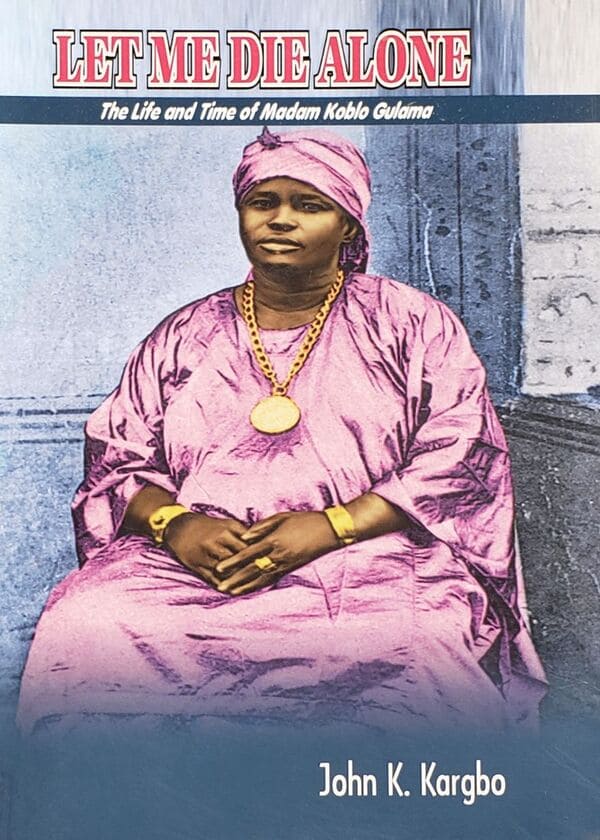
Book review on Let Me Die Alone by John K. Kargbo
Colonial oppressed and feminine Rulership
Publisher: Extension Publications Ltd.Ibadan
It consist of 105 pages,three Acts,Act 1 consist of 3 scenes,Act 2 consist of 6 pages, Act 3 consist of 4 scenes.
John K. Kargbo, in his play, Let Me Die Alone, sums up the prevalence of betrayal in a typical African traditional society. Its setting in Senehun and Moyamba villages of the Mende Kingdom, the play brings to prominence the evils and disasters the desperation for power and the infidelity of one’s trusted persons can inflict on the society. There is a reflection of what evil excessive desire for power portends.
The duo of Musa and Lamboi, blinded by their inordinate crave for power (i.e the throne of the chief), betray two successive chiefs. They are also directly involved in the murders of both Gbanya and Jeneba and by extension, the suicidal death of Yoko.
The play opens with the lovemaking scene between Gbanya, the chief of Senehun and Yoko, his favourite among his thirty seven wives. A guard interrupts their romance with a message that the Colonial Governor is on his way to Senehun.
Gbanya is saddened by the intended visit of the Governor and preoccupied by the dreams he has had before now about his father calling him home. In Africa, when the predecessor of a king or chief calls him, what this means is that the incumbent will soon join his ancestors.
In the light of this, Gbanya has the premonition that something bad will happen to him soon. The knowledge that he sided John Caulker against his brother, George Caulker in an all white war further confirms his fears and unseats his heart.
At first, Yoko tries to dissuade him from engaging himself with such negative thoughts. Later when the latter is unyielding to her advice, she reminds him of his promise to bequeath the throne to her at his demise. Gbanya objects vehemently to such arrangement. He lays claim to the fact that Mende Land is in a state of chaos and disorder. It needs a man to right the wrongs.
We encounter Musa and Lamboi next. Those two are presumably members of Gbanya’s administration. Lamboi, who wants to become the chief, seeks for the cooperation of Musa in killing Gbanya. At first, Musa refuses to oblige to Lamboi’s evil agenda. He later accepts to help when Lamboi threatens to reveal his secret of human sacrifices.
The anticipated Colonial Governor, Dr Rowe, comes to Senehun and as expected, he outrightly humiliates Gbanya for supporting a white brother against the other. Lamboi and Musa capitalize on this and poison Gbanya after the Governor has left.
This image has an empty alt attribute; its file name is screenshot_20200903-1919352.png
While in his death throes, Gbanya is quick to recognize he has been poisoned and the reason he is poisoned. He attempts to hand over power to Yoko before he dies. He dies while doing so.
Triumphantly, Lamboi proclaims himself the new chief. However, suspicious Yoko, who is convinced that Gbanya has been killed by the duo, objects to the pronouncement. She assumes the mantle of leadership instead.
In the following scenes, there is a rapid growth in Yoko’s powers with her servitude to the Governor and the expansion of her chiefdom. We witness a shift in her government’s seat from Senehun to Moyamba.
We also witness the infidelity of Jilo to Ndapi. Jilo is involved in extra marital affairs with Lansana. Ndapi, the chief warrior, is portrayed as a woman-beater, one who maltreats his wife. Jilo would later seek solace in her affair with Lansana. Their only daughter, Jeneba by name, a very sharp young girl, visits the palace frequently.
Yoko who has had enough powers already wishes she can switch places with one of her attendants. Being a Poro woman, Yoko can not conceive. She wishes she is a mother instead of a queen.
While this is on, Musa and Lamboi do not relent in their ploy to eliminate Yoko and take the kingdom for themselves. They marvel at how Yoko has successfully managed the affairs of the chiefdom and her dexterity in maintaining a good diplomatic relationship with the Governor. They decide to kill Jeneba and incite the people against her (Yoko).
The effect of the betrayal and humiliation made Yoko commit suicide.
John K. Kargbo, dives deep into the cutthroat world of power dynamics and betrayal in a traditional African society. Set in the Mende Kingdom's Senehun and Moyamba villages, the story unfolds with Gbanya, the chief, grappling with premonitions of his demise. His trusted aides, Musa and Lamboi, fuelled by insatiable ambition, orchestrate his downfall, poisoning him after a humiliating encounter with the Colonial Governor.
The play masterfully exposes the destructive nature of unchecked desire for power. Musa and Lamboi's betrayal is a stark reminder of how trust can be exploited, echoing the treachery often hidden beneath the fabric of societies. Gbanya's death paves the way for Yoko, his wife, to seize leadership, showcasing a shift in power dynamics. Her reign, marked by strategic diplomacy with the Governor, ironically sets the stage for her own downfall, as Musa and Lamboi plot her ouster.
Kargbo skillfully intertwines themes of colonial influence, gender roles, and societal chaos. Yoko's struggles as a leader, her barrenness, and the objectification of women (seen in Ndapi's treatment of Jilo) add layers to the narrative. The writer's portrayal of a society torn between tradition and external pressures paints a vivid picture of a community in turmoil.
The characters, though rooted in their context, feel universally relevant. Gbanya's vulnerability, Yoko's resilience, and the duo's ruthlessness leave a lasting impact. Kargbo’s storytelling is both poignant and thought-provoking, m