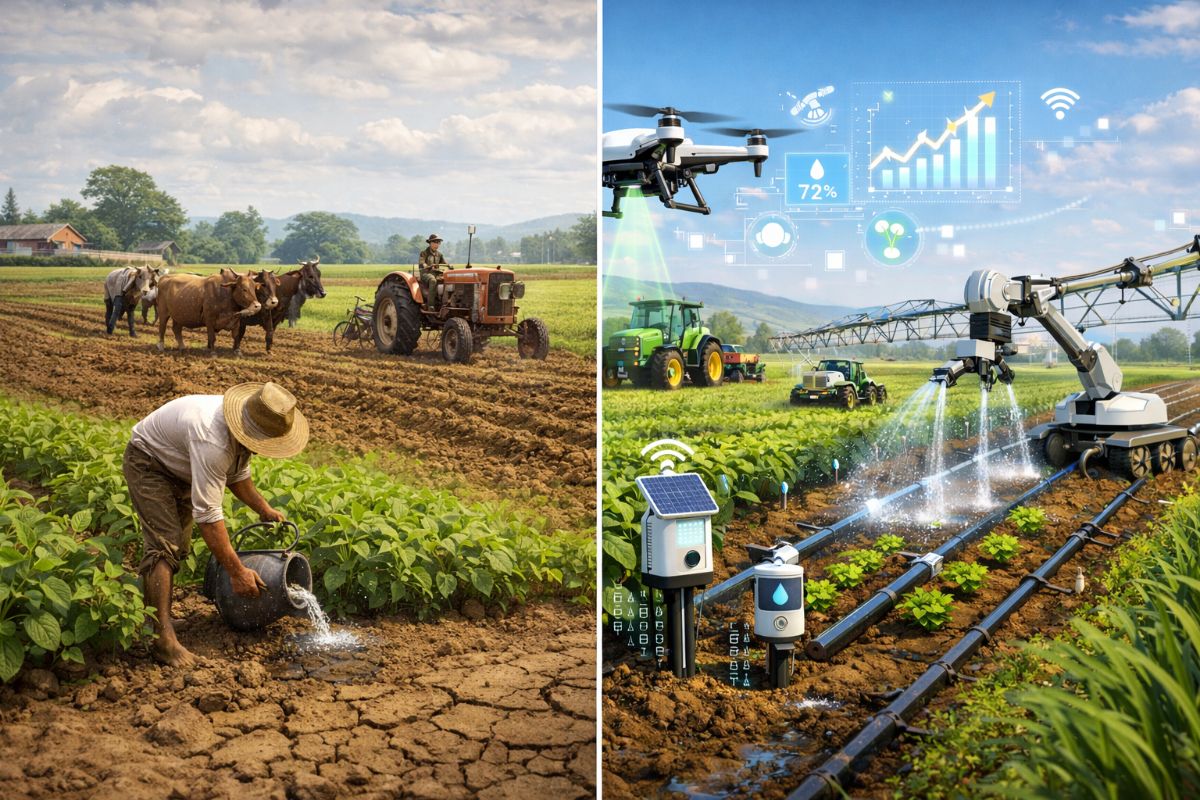
From Humble Beginnings to Smart Farming: The Evolution of Agriculture
Agriculture was not always the way we see it now, the highly mechanized and technology-driven system. In the beginning, it was simply a farmer, the land, and the power of human thinking. No machines, no data, just observation, experience, hard work, and persistence.
Before farming existed, humans survived through hunting and gathering. Imagine moving from place to place, chasing animals and relying on seasonal plants for food. Life was simple, yet demanding and uncertain but everything changed when humans discovered that plants could be deliberately cultivated and animals domesticated. This discovery marked the birth of agriculture.
With farming came a shift from a nomadic lifestyle to permanent settlements. Early farmers depended heavily on rainfall and natural seasons, which made food production unpredictable. Over time, challenges such as drought, poor soil fertility, and low yields pushed humans to innovate. This led to the development of irrigation systems, allowing water to be controlled and used efficiently rather than relying solely on rainfall. Practices like crop rotation, the use of manure and early fertilizers, and improved farming tools also emerged. Tools evolved from simple wooden and polished stone implements to more durable bronze and later iron tools during the Bronze and Iron Ages.
As in the nature of humans, curiosity and the need for efficiency grew as farmers sought better ways to reduce hard labour, save time, and increase food production. This desire gave rise to agricultural mechanization, largely driven by the Industrial Revolution. Machines such as the seed drill, steam-powered equipment, tractors, harvesters, and threshers transformed farming. These innovations made farming faster, reduced physical stress, and significantly increased food output.
Agricultural development did not stop there. The era of scientific farming introduced chemical fertilizers, pesticides, herbicides, and improved farming methods. This period also witnessed the Green Revolution, marked by high-yield crop varieties, controlled irrigation, and the combination of science with mechanized farming to meet the food demands of a growing population.
Today, agriculture has entered its most advanced phase- DIGITAL AGRICULTURE #SMARTFARMING. Technology now plays a central role, from improving seed quality to monitoring plant growth in real time. Farmers can make precise decisions about water usage, soil moisture, humidity, and temperature using sensors, data analytics, and automation. Farming has become smarter, more efficient, and more sustainable.
Agriculture, like many of us, started with limited resources. Yet through curiosity, innovation, and determination, it has grown steadily, transforming from simple survival farming into a powerful system that feeds the world.