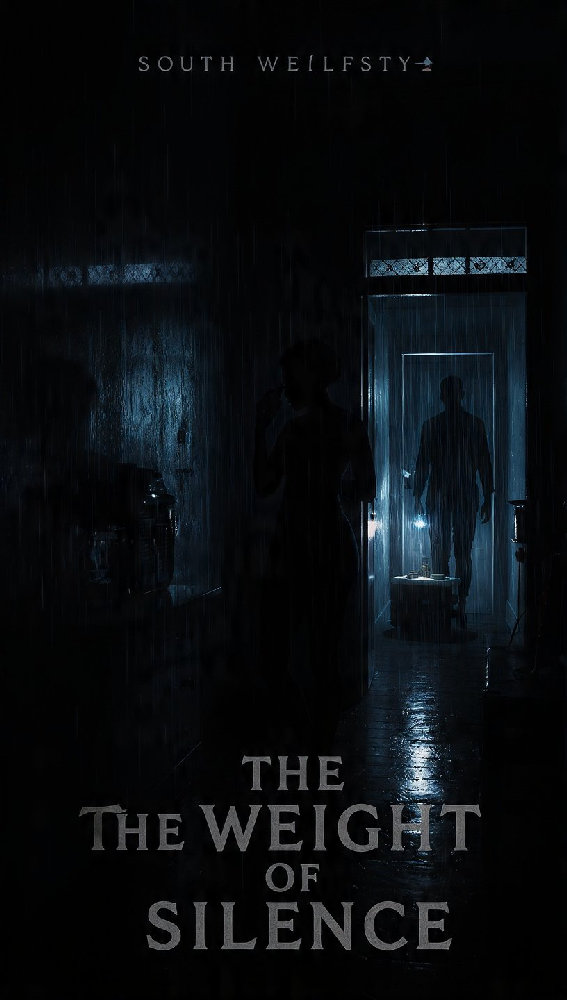
*ACT I: THE WEIGHT OF SILENCE*
Amaka’s father, Chief Donald, is a man whose presence is defined by noise. When he enters their mansion, the house echoes with the loud boisterous laughter of his sycophants, the clinking of expensive champagne glasses, and the heavy thud of his polished leather shoes on marble.
But today, in Amaka's small room, there is only a suffocating quiet. The rain outside creates a low, gray wall of white noise. Every breath she takes sounds incredibly loud. She presses play on the audio file one last time to be sure.
Through the phone's speaker, her father’s voice comes through, sharp and clear, discussing the embezzlement of public funds meant for the local state hospital—the same hospital where Amaka’s mother died the previous winter due to a lack of working oxygen tanks. The tinny, digital sound of his voice fills the small room, making her skin crawl.
*ACT II: THE DISRUPTION*
Suddenly, the generator outside cuts out. The low, steady hum of the plant dies instantly. The sudden drop in sound makes Amaka gasp. It feels as if the entire world has held its breath.
Then comes the sound she dreads: the heavy, rhythmic creak of the wooden floorboards in the hallway outside her room. Step. Creak. Step. Creak. It is her father’s signature walk.
Amaka’s heart beats like a talking drum, a rapid thud-thud-thud that she can feel in her throat. She scrambles to hide the phone under her pillow. The metallic click-clack of her door handle turning sounds like a gunshot in the quiet house.
Chief Donald steps into the room. He doesn't say a word. He just stands in the doorway, blocking the light. The only sound is the heavy, wet rasp of his breathing—the sound of an angry, powerful man who knows he is being cornered.
*ACT III: THE CONFRONTATION*
"Amaka," Chief Donald says. His voice is a low, gravelly rumble that vibrates through the floorboards. "Give me the phone."
Amaka stands up, her knees shaking, but she holds her ground. "No, Daddy. It's over. Everyone is going to hear what you did."
Chief Donald takes a step forward. Instead of shouting, he speaks in a terrifyingly soft whisper. "You think you can survive the noise this will make? You will ruin this family."
Outside, a sudden, violent crack of thunder rips through the sky, rattling the glass windows of the bedroom. The sonic boom shatters the tension in the room. In that exact split second of acoustic chaos, Amaka ducks past her father, bolts out of the room, and runs down the stairs.
*ACT IV: THE RELEASE*
She bursts through the front door into the pouring Lagos rain. The sound landscape changes instantly and aggressively. The deafening roar of the downpour, the splash of her bare feet hitting the flooded driveway, and the distant, chaotic blaring of car horns on the main street swallow her up.
She pulls the phone from her pocket, her fingers wet and slipping on the screen. Chief Donald appears on the veranda, shouting at his security guards, but his voice is completely drowned out by the roar of the storm. He has lost his power; the environment has stripped him of his voice.
Amaka hits "Send."
A soft, digital whoosh sound emits from her phone. The message is gone. The truth is out. Amaka stands in the middle of the rain, water streaming down her face, as the chaotic sound of Lagos embraces her. For the first time in her life, she feels entirely free.
---
*THE IMPACT OF SOUND IN MODERN AFRICAN CINEMA*
_Analysis drawn from the story above_
*1. Sound as Narrative Engine*
The `tinny phone recording` is the entire plot. Without that sound, there is no story. Modern African films like _The Black Book_ now use sound to drive the narrative, not just support it.
*2. Sonic Contrast as Social Commentary*
The mansion’s `artificial quiet + laughter + champagne` = corrupt, isolated wealth.
The street’s `roaring rain + horns + splashing` = raw, real Nigeria.
Sound highlights the clash between elite and reality.
*3. The Power of Silence as a Dramatic Weapon*
When the `generator cuts out`, the world holds its breath. Suspense becomes unbearable. Modern cinema uses silence to signal power shifts and build tension, as seen in _Mami Wata_.
*4. Psychological Scoring*
No music was used. Only `heartbeats like talking drums, breathing, creaking floors`.
This strips away distraction and forces the audience into Amaka’s panic and anxiety.
*5. Atmospheric Texturing / Sonic Authenticity*
Sounds like `generator dying, rain on zinc, creaking wood, Lagos traffic` ground the film in a distinct Nigerian reality. Modern African cinema is archiving its own sound library instead of borrowing Western SFX.
*6. Sound as Location / ID Card*
You hear 3 seconds and you know: This is Lagos. This is Nigeria.
Danfo horns, NEPA hum, rain on zinc = instant geography without a title card.
*7. Sound as Power Dynamic*
Chief Donald’s power = `noise`. When the `storm drowns his voice`, he loses control.
Amaka wins with a soft `whoosh`. Sound shows who has power in the scene.
*8. Sound for Suspense and Timing*
`Step. Creak. Step. Creak.` The pause before thunder.
Sound directs when the audience should feel fear, shock, or relief.
*9. Sound as Cultural Identity*
`Heart beating like talking drum.` That’s not just rhythm, that’s culture.
Modern African films use indigenous sounds, languages, and textures to tell African stories in an African way.
*10. Technical Standard & Global Distribution*
That recording had to be `sharp and clear` to be evidence. A `BRMMMM` would ruin it.
Streaming platforms now demand clean ADR, foley, and Dolby. Sound quality determines if a film gets picked up globally.
---
*CONCLUSION*
*Picture makes you watch. Sound makes you believe you are there.*
In modern African and Nigerian cinema, sound is character, setting, suspense, culture, and truth.
3