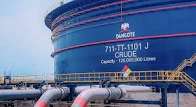
The Dangote Petroleum Refinery has imported its first cargoes of crude oil from the United Arab Emirates, underscoring a strategic shift in feedstock sourcing as Nigeria’s flagship mega-refinery grapples with tight domestic supplies.
Industry data and market sources indicate that two UAE cargoes have been secured, marking the first time the 700,000-barrels-per-day facility has turned to any Middle Eastern supplier. Until now, the refinery’s crude slate has been dominated by Nigerian grades, supplemented by African and United States barrels.
The move comes against the backdrop of renewed stability in Middle Eastern exports following an interim understanding between the United States and Iran that eased tensions and restored confidence in shipping through the Strait of Hormuz, a critical chokepoint for global oil flows.
Dangote’s plant, configured primarily for Nigeria’s light sweet crude, has been steadily widening the range of grades it can process as it ramps up operations. A supply agreement with the Nigerian National Petroleum Company was expected to deliver 13 to 15 cargoes of Nigerian crude each month, paid for in naira to limit the refinery’s exposure to foreign exchange volatility.
However, that arrangement has been undermined by insufficient crude availability and recurring disruptions at export terminals, forcing the refinery to look offshore for additional volumes. Executives have acknowledged that these constraints made diversification away from an almost exclusive reliance on Nigerian barrels unavoidable.
The refinery’s long-term expansion plans are sharpening that urgency. Dangote aims to double processing capacity to 1.4 million barrels per day by the end of 2028, a scale that would allow the complex to handle roughly 80 per cent of Nigeria’s recent crude output in a single day, if domestic supply were available.
Chief Executive Officer David Bird has signalled a deliberate pivot toward heavier grades, including those from the Middle East, to optimise the refinery’s product slate. He has outlined plans for crude blending that could see Middle Eastern grades account for about 30 per cent of the feedstock on each processing train once full expansion is achieved.
Market intelligence shows that as the refinery moves toward operating as a fully merchant facility, it has already diversified its intake: a dominant share of imports still comes from Nigeria, but a growing portion is sourced from the United States and, increasingly, the Gulf.