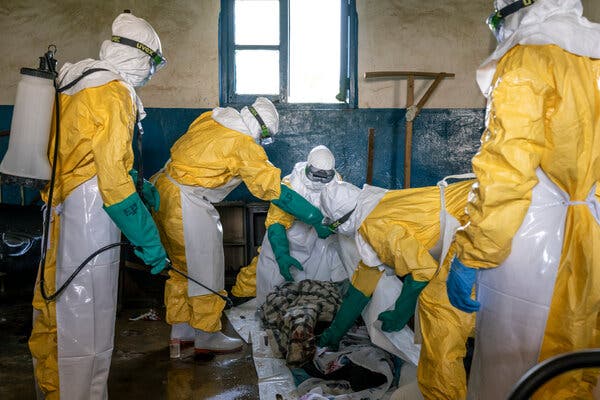
In Bunia, a tense city at the heart of the Democratic Republic of Congo’s latest Ebola outbreak, the Elikya clinic has become a symbol of a health system pushed to breaking point. Corridors meant for transit now serve as makeshift wards, and plastic chairs double as beds as patients continue to arrive faster than staff can triage them.
“We’re overwhelmed because, given the influx of patients, we have a lot of patients but nowhere to put them,” said Dr. Yazid Yassin, medical director of Elikya. “We’re in the process of getting organised and we hope that in a short time the centre will be up and running and we’ll be able to address these problems.”
The current outbreak has spread across three provinces in northeastern Congo, with Ituri province, where Bunia lies, identified as the epicenter. Africa’s Centres for Disease Control and Prevention estimates that Ituri alone accounts for the vast majority of confirmed infections and deaths. The World Health Organization has reported hundreds of confirmed cases and dozens of deaths, underscoring the speed with which the virus has taken hold.
Health authorities say the Bundibugyo strain of Ebola, a relatively rare variant, is responsible. Investigators believe it circulated quietly for weeks, possibly months, before the first clusters were detected, allowing the virus to seed remote communities with limited access to medical care.
Inside Elikya, the pressure is relentless. Staff work in layers of protective gear in stifling heat, moving between suspected and confirmed cases while trying to prevent cross-contamination. Supplies of gloves, disinfectant and intravenous fluids are stretched thin, and every new admission forces difficult decisions about space and staffing.
“Managing it is complicated because we’re in the rising phase, with new cases coming in all the time,” Dr. Yassin said. “The population itself hasn’t yet accepted or agreed to do what’s needed to eradicate this disease. That’s how it is: we’re going to have a lot of patients, but measures are being put in place, including communication and raising awareness. I hope that in a short time we’re going to eradicate this disease.”
Ebola, transmitted through close contact with bodily fluids, has killed more than 15,000 people across Africa over the past half-century. In Bunia, the struggle to contain it now hinges on a fragile alliance between exhausted health workers and communities still learning to trust them.