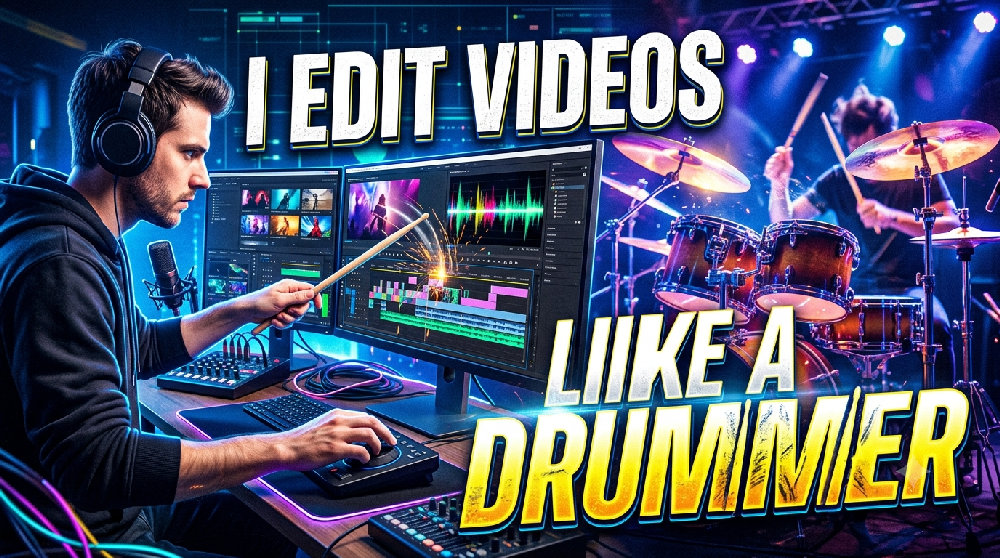
For a long time, I thought I had two completely different passions.Music on one side. Filmmaking on the other.I’m a drummer, but I’m also a filmmaker and video editor. And for years, I treated those two parts of my creativity as completely separate.Drumming was something I did with music.Editing was something I did with visuals.But recently, I started noticing something.The more I learned about music, the more I realized that I was using those same principles when I edited videos.
Editing Has Rhythm
Think about a song.A drummer isn’t just hitting drums randomly. There’s rhythm, timing, pacing, accents, dynamics, pauses, and silence.The drummer knows when to play.But just as importantly, they know when not to play.Editing works the same way.A good edit isn’t simply about putting clips together. It’s about controlling the rhythm of the story.When should the cut happen?Should the next shot come immediately, or should we stay with the current moment for another second?Should the music build?Should everything suddenly become quiet?Should the cuts become faster?Or should we slow everything down and let the audience breathe?Those decisions are what shape how a scene feels.
Knowing When to Cut
One of the biggest things music has taught me is that timing matters.You can play the right note at the wrong time and completely change the feeling of a song.The same thing can happen in editing.You can have the perfect shot, the perfect transition, and the perfect sound effect—but if you introduce them at the wrong moment, they won’t have the impact they could have had.Sometimes the best cut is the one that happens quickly.Sometimes the best decision is to hold the shot.Sometimes silence communicates more than another line of dialogue ever could.Editing is about feeling the moment.
Building and Releasing Tension
Music also taught me about dynamics.A song doesn’t stay at the same intensity from beginning to end.It builds.It drops.It gets louder.It becomes quieter.And sometimes, everything stops for a moment before the music comes back even stronger.Visual storytelling works in much the same way.If every shot is intense, nothing feels intense anymore.If every cut is fast, fast cuts stop feeling special.If every moment is filled with music and sound, silence loses its power.Contrast creates impact.As an editor, I’m learning to think about a scene almost like a musical performance.Where is the build-up?Where is the climax?Where should I pull back?Where should I let the audience sit with what just happened?
Maybe Our Passions Aren’t Separate
This realization has changed the way I see being multi-talented.For a long time, I thought having multiple interests meant I had to eventually choose one.Music or filmmaking.Drumming or editing.But maybe that’s not the point.Maybe the real value of having different skills is discovering the connections between them.What I learned from drumming is influencing how I edit.What I learn from filmmaking can influence how I create music.And the more I explore both, the more I realize that creativity doesn’t always fit neatly into separate boxes.Sometimes, one passion is quietly teaching you how to become better at another.So now, when I sit in front of an editing timeline, I don’t just think like an editor.I think like a drummer.I listen for the rhythm.I feel the timing.I look for the accents.I pay attention to the silence.And most importantly, I think about when the next beat should come.Maybe being multi-talented isn’t about choosing one thing.Maybe it’s about finding the connections between the things you love.