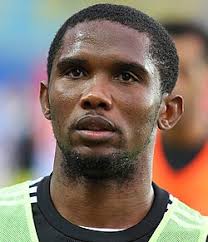
Samuel Eto’o, one of African football’s most celebrated figures and now president of the Cameroonian Football Federation, has been handed a four-match suspension and a $20,000 fine by the Confederation of African Football after being found guilty of misconduct during the Africa Cup of Nations qualifying campaign for the 2026 tournament.
The punishment follows Eto’o’s behaviour during Cameroon’s quarter-final defeat to hosts Morocco in Rabat, a high-stakes encounter that ended 2-0 in favour of the Atlas Lions. According to CAF’s disciplinary body, Eto’o violated the principles of sportsmanship through his conduct on the touchline and in his interactions with match officials.
CAF’s statement described the incident as a serious breach of the code of conduct expected from senior football officials, particularly someone in Eto’o’s position as head of a national federation. The former striker was reportedly seen making angry and demonstrative gestures in response to refereeing decisions, repeatedly confronting the officials and expressing his displeasure in a manner CAF deemed excessive and inappropriate.
CAF president Patrice Motsepe was in the stadium for the match and is understood to have personally witnessed the scenes that later formed part of the disciplinary file. In the days that followed, CAF announced a broader investigation into what it called “violent confrontations and unacceptable behaviour of some players and officials” during the quarter-final stage of the competition, signalling that the governing body intended to take a firm line on discipline.
The case against Eto’o was handled by CAF’s Disciplinary Board, which reviewed match reports, video footage and written submissions before issuing its verdict. The four-match ban applies to official CAF competitions in which Eto’o would participate in an official capacity as president of the Cameroonian Football Federation, known by its French acronym FECAFOOT. The financial penalty of $20,000 was imposed alongside the suspension, with CAF stressing that senior officials must set an example in respecting referees and the integrity of the game.
FECAFOOT has reacted angrily to the decision, publicly rejecting both the process and the outcome. In a strongly worded statement, the federation said the disciplinary procedure “raises serious reservations about the fundamental requirements of a fair trial,” arguing that Eto’o had not been given sufficient opportunity to defend himself and that the evidence had been interpreted in a biased manner.
The Cameroonian body expressed full support for its president and indicated that it would lodge an appeal with CAF’s internal judicial structures, and, if necessary, pursue the matter further through the Court of Arbitration for Sport. FECAFOOT’s leadership framed the case as part of a broader pattern of what it sees as unfair treatment, insisting that Eto’o’s passion on the touchline had been mischaracterised as misconduct.
Eto’o himself has not issued a detailed public statement on the ruling, but those close to him have suggested he views the sanction as disproportionate. Supporters of the former striker argue that emotional reactions are common in high-pressure matches and that his behaviour, while animated, did not cross the line into violence or incitement. Critics, however, say that as a federation president, Eto’o is held to a higher standard than players or coaches and must embody restraint even in the most intense moments.
The episode adds another layer to an already turbulent presidency. Eto’o, a four-time African Footballer of the Year and a Champions League winner with Barcelona and Inter Milan, took charge of FECAFOOT with a promise to modernise Cameroonian football, improve conditions for players and restore the country’s status as a continental powerhouse. His election was greeted with enthusiasm by many fans who saw in him a charismatic reformer with global stature.
Since then, his tenure has been marked by both visible reforms and persistent controversy. Under his leadership, FECAFOOT has pushed for better organisation of domestic competitions, attempted to professionalise club structures and sought to renegotiate commercial deals to bring more revenue into the game. Eto’o has also been vocal about improving player welfare, including timely payment of bonuses and salaries, long a sore point in Cameroonian football.
At the same time, he has faced a series of allegations and disputes. Local stakeholders, including some club officials and former federation figures, have accused him of centralising power, sidelining critics and failing to follow established governance procedures. Questions have been raised about transparency in decision-making, the management of sponsorship contracts and the handling of disputes with coaches and players.
Internationally, Eto’o has also been the subject of separate investigations and media reports concerning alleged match-fixing discussions and conflicts of interest, which he has consistently denied. He has portrayed himself as the target of a campaign to undermine his reforms, insisting that entrenched interests threatened by change are behind many of the accusations.
The CAF sanction over the AFCON quarter-final incident will likely deepen existing divisions within Cameroonian football. For his supporters, it will be seen as further evidence that Eto’o is being unfairly singled out. For his detractors, it will reinforce the argument that his temperament and leadership style are incompatible with the demands of high office in football administration.