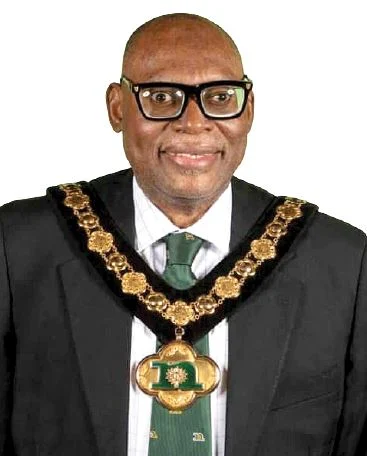
When Christopher Adegoke took his seat as Chairman of Nottinghamshire County Council, he quietly made history. For the first time since the council was created in 1889, its first citizen was a Black man, a Nigerian-born son of Koro in Kwara State whose journey to the top of local government began in crowded classrooms thousands of miles away.
Adegoke grew up under the watchful eye of his father, Oba Elijah Adegoke Oyun, the late Olu Koro of Koro, who preached a simple creed: education could carry any child as far as their talent and character would allow. From Kaduna to Lagos and then Ilorin, the young Christopher moved with his father’s work, attending a string of primary schools before progressing to ECWA Secondary School, Igbaja, and Government Secondary School, Ilorin.
Those early years, he recalls, were less about comfort and more about character. Exposure to different cultures and communities across Nigeria taught him adaptability, respect and curiosity. At Kwara State Polytechnic, he found his voice, becoming the first Marshal of the institution’s Jazz Club, before going on to the University of Ilorin to study History and later Public Administration.
Public service, he says, was almost hereditary. His father was a traditional ruler, while siblings, an uncle and a cousin all held leadership roles in religious, educational and local government spheres. When he eventually settled in the United Kingdom, community work and then politics felt like a natural extension of that legacy.
As a councillor in Nottinghamshire, Adegoke built a reputation for accessibility rather than rhetoric. He insists that integrity, humility and discipline are the strongest antidotes to the subtle barriers minorities can face. “When people see you are sincere and willing to help,” he notes, “they will work with you.”
His elevation to chairman is, for him, both personal vindication and a public signal that British politics can reward merit from any background. He intends to use the office to deepen inclusion, strengthen community engagement and ensure that “no one is left behind” in Nottinghamshire.
To young Nigerians watching from afar, he offers a measured challenge: do not abandon politics, and do not abandon your dreams. Participation, he argues, is the only way to change flawed systems. With resilience, discipline and hard work, he believes, the next generation can go further than he has — whether in Kwara, Nottinghamshire or beyond.