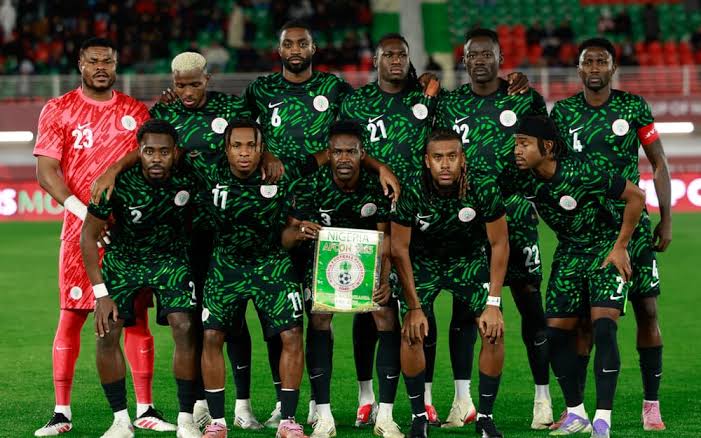
The Super Eagles have retreated from the spotlight in Rabat, holding a closed training session as they sharpen their plans for a high stakes Africa Cup of Nations semi final against host nation Morocco.
The session took place at the state of the art Complexe Mohammed VI, a sprawling facility on the outskirts of the Moroccan capital that has become the tournament’s central hub for elite preparation. With security cordons in place and access tightly controlled, only players, coaches and essential backroom staff were allowed inside the training bowl as Nigeria’s technical crew put the squad through an intense workout.
Team media officer Promise Efoghe explained that the decision to bar spectators and journalists from the bulk of the session was deliberate and strategic. According to him, head coach Eric Chelle wanted the freedom to rehearse specific tactical patterns, set piece routines and in game adjustments without the distraction of cameras or the risk of sensitive information leaking to the opposition camp.
Behind the closed gates, the focus was on detail. The coaching staff are understood to have divided the squad into units, with defenders working on compactness, line coordination and transitions, while midfielders and forwards drilled combination play, pressing triggers and finishing under pressure. Goalkeepers were put through a separate, high intensity programme, with particular emphasis on dealing with crosses and one on one situations, both of which are expected to be crucial against a Moroccan side that thrives on quick wide play and late runs into the box.
Fitness and recovery have also become central themes of Nigeria’s preparation. With the tournament schedule compressing matches into short cycles, the medical and performance teams have been monitoring workloads closely, using GPS data and recovery protocols to keep players fresh. Light conditioning, stretching and ice bath routines followed the main tactical session, underscoring the staff’s determination to arrive at the semi final with a squad as close to peak condition as possible.
While Monday’s training was completely closed, Efoghe confirmed that the media will be allowed to observe the opening 15 minutes of Tuesday’s session. That brief window is expected to feature warm ups, rondos and basic ball work before journalists and cameras are ushered out and the team returns to private drills. It is a compromise that allows the national side to maintain a degree of transparency and engagement with supporters, while still protecting the finer points of their game plan.
The stakes could hardly be higher. Nigeria are chasing a place in their second AFCON final since their triumphant run in 2013, when they lifted the trophy and reasserted their status as one of the continent’s traditional powerhouses. More recently, they came agonisingly close in Ivory Coast, finishing as runners up after a campaign that rekindled belief but also left a lingering sense of unfinished business.
That history hangs over the current squad. Many of the players have spoken in recent days about the desire to go one step further, to convert promise into silverware and to restore Nigeria to the summit of African football. The semi final against Morocco offers both a formidable challenge and a clear pathway. Beat the hosts in their own backyard and the Super Eagles will not only reach the final but also send a powerful message about their resilience and ambition.
Morocco, for their part, come into the tie buoyed by home support and a reputation for tactical discipline. Their recent performances at both continental and global level have been built on a solid defensive structure, quick transitions and a willingness to press aggressively in key zones. Playing at the Prince Moulay Hassan Stadium in Rabat, they will expect to dictate the tempo, backed by a partisan crowd eager to see the hosts advance.
That atmosphere is one of the reasons Nigeria’s staff have been so keen to fine tune their approach away from prying eyes. Managing the emotional swings of a semi final on foreign soil, coping with noise and pressure, and maintaining concentration in critical moments are all themes that have reportedly been addressed in team meetings and on the training pitch. The closed sessions allow coaches to simulate scenarios, rehearse communication and reinforce the mental framework required to navigate such an occasion.
Selection decisions remain closely guarded. The private nature of training has fuelled speculation about possible tweaks to the starting lineup and shape. Chelle has options across the pitch, with a blend of experienced campaigners and emerging talents pushing for inclusion. Whether he opts for a more conservative setup to absorb Moroccan pressure and strike on the counter, or a bolder, front foot approach to disrupt the hosts early, is likely to remain unknown until the teams walk out for warm up.
What is clear is that the Super Eagles are treating every detail as decisive. From set piece routines to pressing schemes, from rest periods to video analysis, the build up has been meticulous. The decision to close Monday’s session is part of a broader pattern of controlled preparation, one that reflects both respect for the quality of the opposition and confidence in Nigeria’s own capacity to execute a well crafted plan.