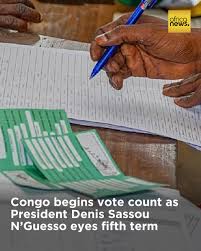
Vote counting has begun in the Republic of Congo after a presidential election widely seen as a test not of power change, but of how firmly President Denis Sassou N’Guesso can tighten his decades-long grip on the country.
Polling stations closed across the Central African nation after a largely calm day of voting, though observers and civil society groups reported a subdued atmosphere and sparse queues in many districts. Official results are expected within days, but few in Brazzaville or beyond anticipate a surprise.
Sassou N’Guesso, 82, is seeking a fifth consecutive term in office, standing again under the banner of the ruling Congolese Party of Labor. Six challengers appeared on the ballot, yet opposition figures and analysts alike say the contest unfolded on an uneven playing field shaped by the incumbent’s long dominance of state institutions, security forces and much of the media.
Several opposition parties urged supporters to stay home, arguing that the outcome was predetermined. That call, combined with widespread disillusionment, appeared to depress turnout, particularly among younger voters who have known no other leader in their lifetimes.
Sassou N’Guesso first came to power in 1979, steering a one-party Marxist-Leninist state before overseeing Congo’s transition to multiparty politics in the early 1990s. Defeated in elections in 1992, he returned to power after a brutal civil war in 1997 and has remained at the helm ever since.
A controversial constitutional referendum in 2015 scrapped presidential age and term limits, clearing the way for his continued rule. Critics say that vote, and subsequent elections, entrenched an increasingly authoritarian system, while the government insists it has followed constitutional procedures and preserved stability in a volatile region.
The latest election comes against a backdrop of deep economic strain in the oil-dependent country. Despite significant petroleum reserves, Congo is burdened by heavy public debt and persistent budget pressures. Youth unemployment is high, and more than half of the population lives in poverty, even as gleaming new infrastructure projects rise in the capital.
For many Congolese, the ballot has become less a choice between competing visions than a barometer of frustration with a political order that feels immovable. If, as widely expected, Sassou N’Guesso secures another term, he will further cement his place among Africa’s longest-serving leaders, alongside Cameroon’s Paul Biya and Equatorial Guinea’s Teodoro Obiang Nguema Mbasogo.