Federal Ministry Of Education, Nigeria in 2000, registering a child for WAEC or NECO cost ₦1,000. Federal Ministry of Finance, Nigeria the minimum wage was ₦5,500 a month. That fee took up less than a fifth of a month's pay.
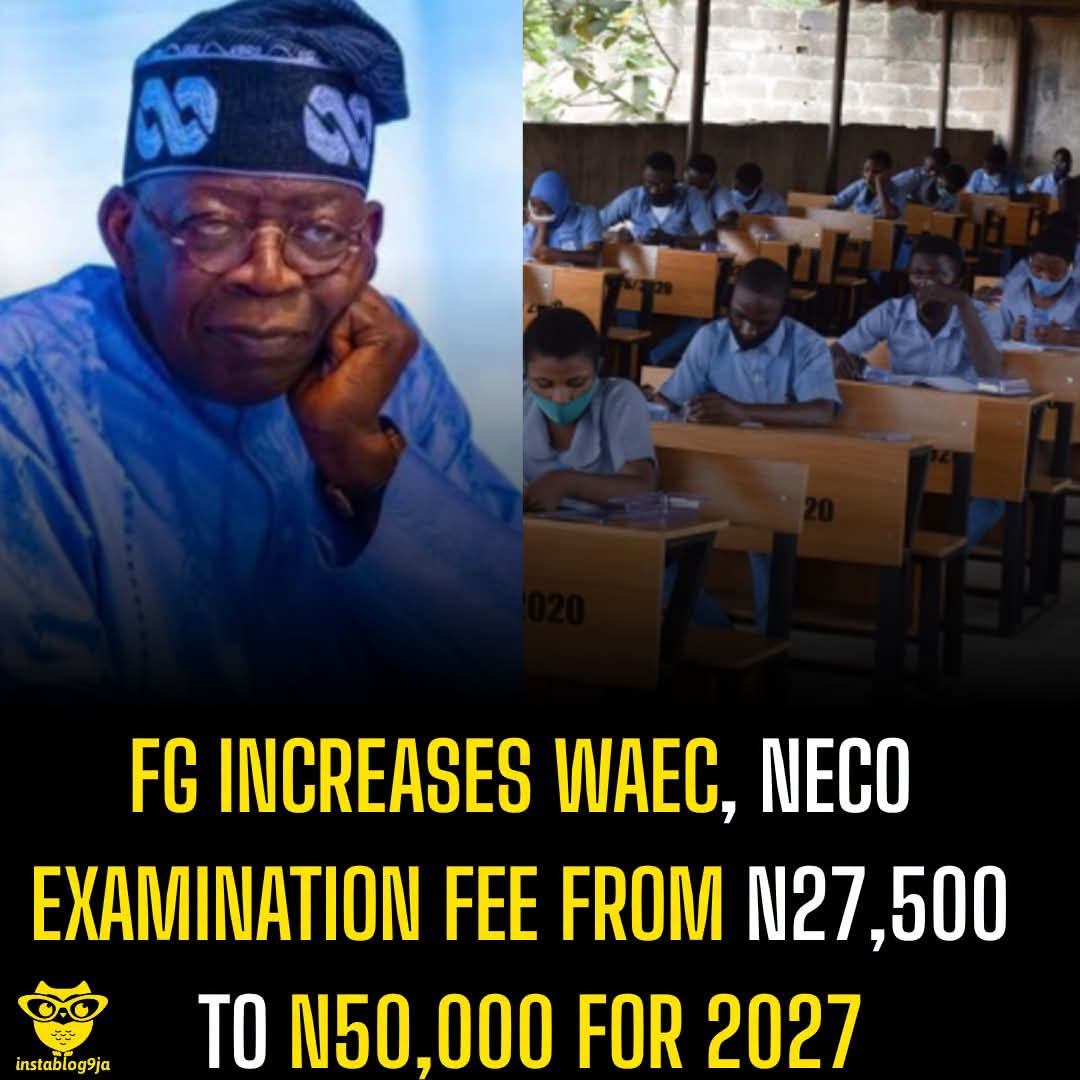
From 2027, a single exam body will charge ₦50,000. Sit both WAEC and NECO, and a family pays ₦100,000. The minimum wage? Still ₦70,000.
So a cost that was 18% of a month's wage in 2000 is now 143% of it.
With resources from the Nigerian Communications Commission, The Vanguard Newspaper, Daily Trust Newspaper, Guardian Newspaper Nigeria; I tracked the numbers year by year:
→ 2000: ₦1,000 fee / ₦5,500 wage (~18%)
→ 2003: ₦2,250 fee / ₦5,500 wage (~41%)
→ 2015: ~₦9,850 fee / ₦18,000 wage (~55%)
→ 2026: ₦27,000–30,000 fee / ₦70,000 wage (~39–43%)
→ 2027: ₦50,000 per body / ₦70,000 wage (71% for one exam, 143% for both)
Two speeds are colliding here. Exam fees move at the speed of a memo; this latest increase, a 82% jump, was approved in June 2026 for the 2027 exams. Minimum wage moves at the speed of a negotiation, revised only five times since 2000.
Nigeria already has an estimated 10.5–15 million out-of-school children. A fee increase in this size doesn't just strain families with the means to absorb it: it quietly filters out the families who don't.
The certificate hasn't changed. What it costs to sit for it has. And the wage meant to cover it hasn't kept pace in over two decades.
What happens to the next generation when the exam meant to open doors becomes the thing that closes them first? Federal Ministry of Communications, Innovation & Digital Economy