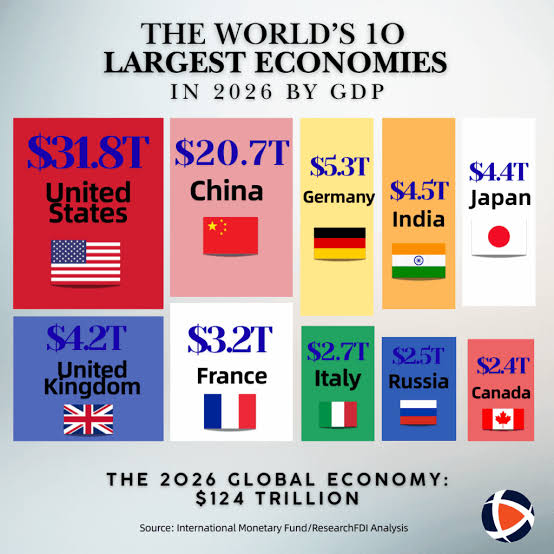
The United States is projected to retain its position as the world’s largest economy in 2026, with nominal gross domestic product estimated at $32.1 trillion, according to forecasts compiled by Focus Economics. The ranking underscores how technology, demographics, and shifting trade patterns are reshaping global economic power.
The U.S. economy, accounting for more than a quarter of global output, is anchored by its dominance in high-value sectors such as artificial intelligence, cloud computing, pharmaceuticals, and advanced manufacturing. Silicon Valley and other innovation hubs continue to attract capital and talent, while Wall Street remains the nerve centre of global finance.
China holds second place with a projected GDP of $20.2 trillion. Its vast manufacturing base, export capacity, and infrastructure investment keep it central to global supply chains. However, analysts note that a shrinking workforce, property-market strains, and high corporate debt could temper its long-term growth trajectory.
Germany, at $5.4 trillion, remains Europe’s largest economy and the world’s third-largest. Its export-driven model is powered by precision engineering, automobiles, and industrial machinery, supported by the Mittelstand network of highly specialised medium-sized firms.
India is forecast to reach $4.5 trillion, overtaking several advanced economies as it consolidates its position among the top four. A young population, expanding middle class, and strength in services and information technology are driving rapid growth, though infrastructure gaps and job creation remain key challenges.
Japan follows closely at $4.4 trillion. It remains a leader in robotics, automobiles, and electronics, but faces persistent headwinds from an aging population, deflationary pressures, and high public debt.
The United Kingdom, projected at $4.2 trillion, is a predominantly service-based economy, with London serving as a global hub for banking, insurance, and professional services. France, at $3.6 trillion, combines industrial strength with world-leading luxury goods, aerospace, and agriculture.
Italy’s $2.7 trillion economy is driven by manufacturing clusters in fashion, machinery, and automotive production, particularly in the north. Russia, at $2.5 trillion, remains heavily reliant on oil and gas exports, leaving it exposed to commodity price swings and sanctions.
Canada completes the top 10 with $2.4 trillion, leveraging abundant natural resources alongside a sophisticated financial and services sector. Economists say these rankings will be increasingly influenced by energy transitions, technological disruption, and geopolitical realignments in the years ahead.




.jpeg?alt=media&token=96b327a5-8e62-4ed1-a078-308aff149ed1)