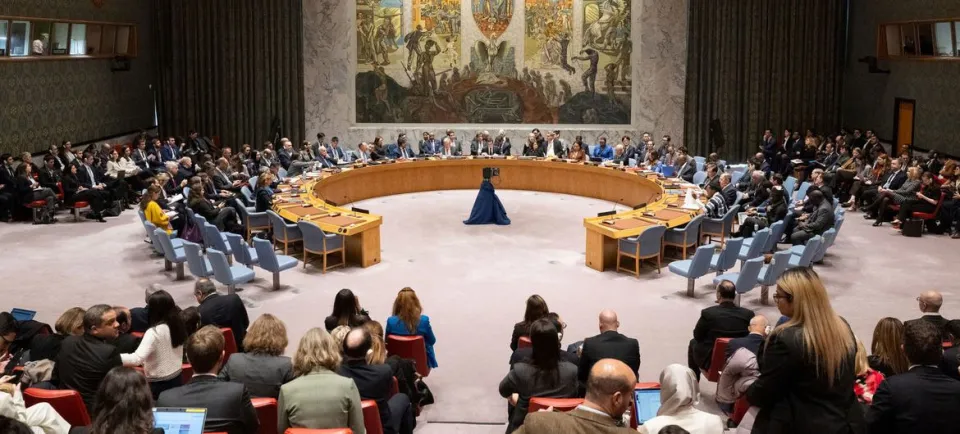
In a recent development at the United Nations, the composition of the Security Council is set to change as five new non-permanent members are elected to replace outgoing representatives from Ecuador, Japan, Malta, Mozambique, and Switzerland, whose terms conclude on December 31st.
Following a secret ballot, the newly elected countries secured the necessary two-thirds majority of Member States present and voting in the 193-member General Assembly, signalling a democratic process in selecting these key representatives.
Joining the existing non-permanent members Algeria, Guyana, the Republic of Korea, Sierra Leone, and Slovenia, whose terms began on January 1st, the new members will play a crucial role in shaping decisions regarding international peace and security.
It's important to note that while the non-permanent members serve on a rotational basis, the Security Council's five permanent members—China, France, Russia, the United Kingdom, and the United States—retain veto power, highlighting the complex dynamics within the Council.
As outlined in the UN Charter, the Security Council holds primary responsibility for maintaining global peace and security, with Member States obliged to adhere to its resolutions and decisions.
The distribution of the 10 non-permanent seats on the Security Council is based on four regional groupings: Africa and Asia, Eastern Europe, Latin America and the Caribbean, and the Western European and other States group.
In this year's election, candidates competed for five seats across three regional groups: two for African and Asia-Pacific, one for Latin America and the Caribbean, and two for Western Europe and other States.
The newly elected members, endorsed by their respective regional groups, largely ran uncontested, indicating a degree of consensus within the international community.
With a total of 190 Member States participating in the election, only a single round of balloting was required to determine the outcome.
In the African and Asia-Pacific group, Pakistan and Somalia received significant support, with Pakistan securing 182 votes and Somalia garnering 179 votes, while five countries abstained.
Similarly, in the Latin America and the Caribbean group, Panama emerged as the clear choice with 183 votes, while Argentina received one vote, and six countries abstained.
In the Western European and other States group, Denmark and Greece received strong backing, with Denmark obtaining 184 votes, Greece securing 182 votes, and Italy and Norway each receiving one vote. Two countries abstained from voting in this group.
The successful election of these new non-permanent members reflects the ongoing commitment of the international community to uphold peace and security on a global scale, underscoring the importance of collaborative efforts within the Security Council.