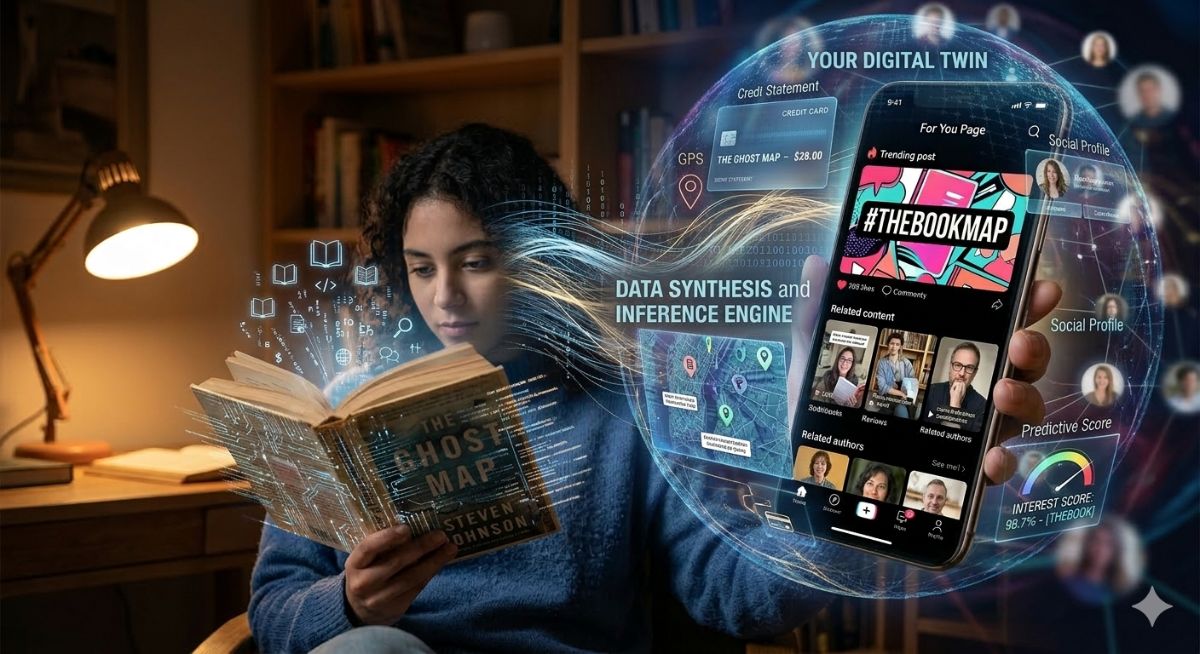
We have all experienced that unsettling moment of digital déjà vu. You’re sitting in a quiet room, flipping through a physical copy of an obscure book, or perhaps you’re just deeply contemplating a specific niche hobby. Then, you pick up your phone, open your social media feed, and there it is: a perfectly timed video or a trending hashtag dedicated to that exact topic. It feels like a glitch in the matrix or, more disturbingly, as if your devices are tapping into your internal monologue. But the reality behind this "psychic" phenomenon is actually a feat of high-level engineering and predictive modeling that is far more sophisticated than a simple hidden microphone. This eerie sensation isn't a single event; it is the result of a massive, silent infrastructure working in the background to turn your private thoughts into public hashtags.
The sensation of being watched is often a byproduct of what data scientists call “Lookalike Modeling”. Instead of needing to hear your thoughts, platforms build a "Digital Twin" of your behavior. This virtual model is constructed from trillions of data points—how long you linger on a specific image, your physical GPS coordinates, and even the browsing habits of people you spend time with. By using Matrix Factorization, the system identifies millions of other users who share your exact behavioral signature, grouping you into digital neighborhoods. If ten thousand people who share your music taste, scroll speed, and age group all suddenly start engaging with a specific book or trend, the system predicts with startling accuracy that you are next. You aren't being recorded; you are simply being calculated.
Beyond your screen, your physical world is much louder than you think. Even when your screen is off, your device is leaking passive Data through an invisible Offline-to-Online Pipeline. When you walk into a bookstore, your device's Identifier for Advertisers (IDFA) may ping against Geospatial Beacons or Bluetooth Low Energy signals. This location data is processed through Data Management Platform almost instantly. Furthermore, if you purchase a book with a credit card, that transaction is often matched to your social media profile via your email or phone number by data brokers. Even Proximity Correlation plays a role; if you spend a few hours at a coffee shop with a friend who just searched for a specific topic, the Inference Engine assumes that because your coordinates matched for a significant duration, you likely share the same interest.
Ultimately, this "mind-reading" effect is a testament to the power of collaborative Filtering and semantic Saliency. Platforms use Natural Language Processing (NLP) to map out an Interest Graph that includes not just your actions, but those of your entire social circle. This is where high-tech Pattern Recognition meets human psychology. We actually scroll past thousands of irrelevant ads every day without noticing them, but the moment we engage with a topic in the physical world, our brains become primed to see it. This is known as Frequency Illusion—flagging the one accurate prediction while filtering out the noise. The tech isn't psychic; it is a mirror of our most predictable patterns, reflected back at us with mathematical precision to create the ultimate sense of digital haunting.
-use on your Insta