The Eiffel Tower: A Marvel of Thermal Expansion
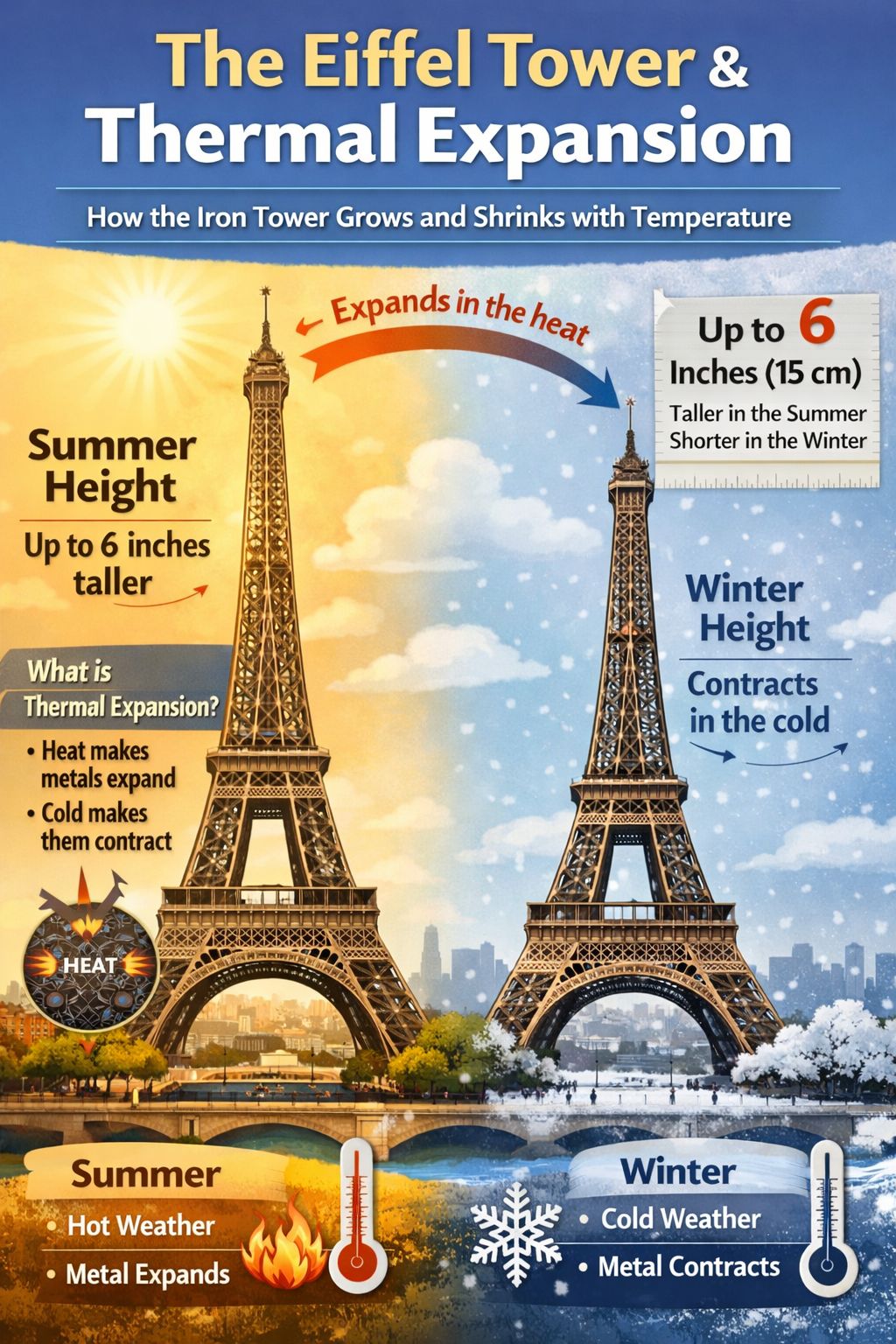
The Eiffel Tower, standing proudly in Paris as one of the world’s most iconic landmarks, is not just an architectural wonder, it’s also a fascinating example of thermal expansion in action. Did you know that during the warmer months, the Eiffel Tower can actually grow in height by up to 6 inches (15 cm)? Let’s take a closer look at how this happens and why it matters.
What Is Thermal Expansion?
Thermal expansion refers to the way materials change in size when they are exposed to heat or cold. As the temperature rises, the molecules in most substances, including metals, move more rapidly and spread further apart. This results in an increase in volume or length. Conversely, when the temperature drops, the molecules slow down and move closer together, causing the material to shrink.
Why Does the Eiffel Tower Expand?
The Eiffel Tower is made primarily of iron, a metal that expands and contracts significantly with changes in temperature. The tower was designed by the French engineer Gustave Eiffel and completed in 1889 as the entrance arch for the World’s Fair. Standing 330 meters (1,083 feet) tall, it is one of the tallest structures in Paris.
Given the size and material of the Eiffel Tower, it is particularly sensitive to fluctuations in temperature. In the summer months, when Paris experiences higher temperatures, the iron structure absorbs heat and expands. This expansion can result in a height increase of up to 6 inches (15 cm). Similarly, in the winter months, when the temperature drops, the metal contracts back to its original size.
How Significant Is This Expansion?
While 6 inches may seem like a minor change for such a colossal structure, it’s a perfect example of how even the biggest and most solid objects on Earth are affected by temperature. The thermal expansion of the Eiffel Tower is measurable and predictable, and it’s a natural physical process that engineers have accounted for since the tower’s construction. Interestingly, the Eiffel Tower is designed to withstand these changes. The flexibility of the metal allows the structure to adjust without causing any damage. The ability to expand and contract is a key factor in keeping the tower stable and safe for visitors, despite the significant temperature fluctuations that Paris experiences over the course of a year.
The Engineering Behind the Expansion
In addition to the iron’s natural properties, the Eiffel Tower was designed with expansion in mind. The engineers accounted for the changes in size and movement that the tower would experience as part of its structural integrity. They ensured that joints and connections were designed to accommodate the expansion and contraction, allowing the tower to breathe and adjust without compromising its stability. The Eiffel Tower’s framework includes over 18,000 individual iron parts held together by 2.5 million rivets. These pieces are connected in such a way that the expansion and contraction of the metal can occur smoothly without warping or damaging the overall structure.
The Role of Temperature in the Tower’s Behavior
The amount of expansion the Eiffel Tower experiences depends directly on the ambient temperature. For example, in the summer, the average daily temperature in Paris can reach around 25°C (77°F), which is enough to cause the iron to expand. In winter, the temperatures can drop below 0°C (32°F), leading the metal to contract. This process is not unique to the Eiffel Tower. All materials expand and contract to some degree with changes in temperature. However, the massive size of the Eiffel Tower makes the effects of thermal expansion more noticeable compared to smaller objects.
Fun Fact: Other Structures That Expand and Contract
The Eiffel Tower is not the only famous structure affected by thermal expansion. The Golden Gate Bridge in San Francisco, made of steel, also expands in hot weather and contracts in cold weather. The change in length can be several inches, depending on the temperature. Even everyday objects like railroad tracks or building foundations are designed with thermal expansion in mind. Engineers make sure that there are gaps or sliding joints in these structures to allow them to adjust without breaking or warping.
Why Does This Matter?
Understanding the principles of thermal expansion is crucial for engineers, architects, and anyone involved in designing large structures. It affects everything from the materials used in construction to the design of joints and connections. In the case of the Eiffel Tower, the engineers who built it in the late 19th century showed incredible foresight by considering this phenomenon when planning the tower’s structure. By recognizing and accounting for thermal expansion, they ensured that the Eiffel Tower would not only stand tall but also adapt gracefully to the changing seasons. It’s a perfect example of how scientific principles like thermal expansion are applied to real-world engineering challenges, allowing us to enjoy some of the most amazing structures on Earth.