BOOK REVIEW
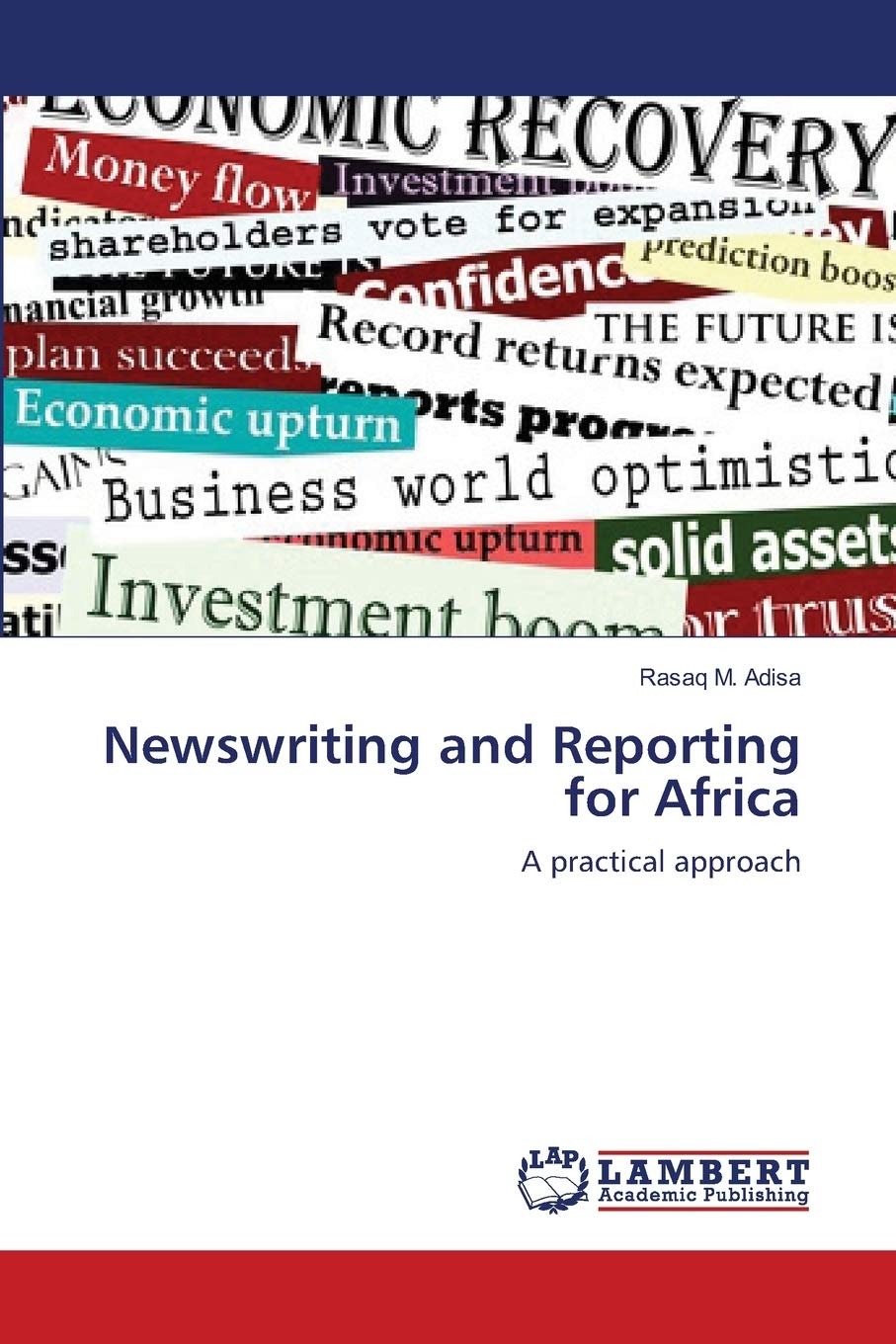
Book Title
Newswriting and Reporting for Africa: A Practical Approach
Author
Rasaq M. Adisa
Publisher
LAP LAMBERT Academic Publishing
Place & Year of Publication
Germany, 2012
Number of Pages
168 pages
ISBN
ISBN-10: 3659174823
ISBN-13: 978-3659174827
Printer
LAP LAMBERT Academic Publishing, Germany
Price
NGN 122,721.48 (Paperback, Amazon Nigeria – excluding shipping and import fees)
INTRODUCTION AND GENERAL OVERVIEW
Newswriting and Reporting for Africa: A Practical Approach is a professional and academic textbook written by Rasaq M. Adisa, a seasoned journalist, public relations practitioner, and journalism lecturer with over fifteen years of practical experience. The book is designed specifically to address the unique realities of journalism practice in Nigeria and across Africa, where reporters operate within complex political, social, legal, and technological environments.
The text consists of 11 well-structured chapters that successfully bridge the gap between journalism theory and newsroom practice. Adisa integrates classical newswriting principles with modern concepts such as precision journalism, social science research methods, and media law. This approach makes the book particularly relevant in today’s multimedia and data-driven journalism landscape. The author’s emphasis on African newsroom realities distinguishes the book from many Western-oriented journalism texts.
SUMMARY OF CONTENT AND CHAPTER FOCUS
One of the strongest aspects of the book is its detailed discussion of news story forms, particularly single-element and multiple-element news stories. Adisa emphasizes that newswriting is not a casual activity but a disciplined professional process that requires planning, structure, and thematic clarity. According to the author, journalists must clearly understand the central idea of a story and avoid unnecessary details that weaken its focus.
The book provides clear explanations of key concepts such as:
The nature of news as a perishable commodity
The importance of planning before writing
Lead construction and story development
The classification of information into essential, secondary, and background details
To enhance understanding, Adisa uses practical newspaper examples from Nigerian dailies such as The Guardian, The Punch, and The Comet. These examples make the explanations realistic, relatable, and especially useful for students and entry-level reporters.
PRECISION JOURNALISM AND RESEARCH METHODS
Another major strength of the book is its extensive treatment of precision journalism, which the author describes as scientific journalism. Adisa explains how journalists can apply social science research methods to improve the accuracy, credibility, and depth of their reports. Topics covered include surveys, sampling techniques, content analysis, data processing, and basic statistical interpretation.
Specifically, the book discusses:
Public opinion polling techniques
Types of opinion polls such as online, tracking, and pseudo-polls
Questionnaire design
Sampling principles and representativeness
Data presentation using percentages, cross-tabulations, and graphs
This section is particularly relevant in modern journalism, where data-driven storytelling and evidence-based reporting have become essential professional skills.
COMMUNICATION LAW AND ETHICS
Adisa devotes an entire chapter to communication law, focusing on issues that frequently affect journalists in Nigeria. These include defamation (libel and slander), privacy, confidentiality of sources, and the balance between free press and fair trial. The author explains these concepts using Nigerian legal frameworks and real-life cases, making the discussion both practical and educational.
The chapter clearly outlines the elements of defamation, available legal defenses, and the ethical responsibilities of journalists. This section serves as an important guide for protecting journalists from legal risks while reinforcing professional standards.
STYLE, LANGUAGE, AND PRESENTATION
The book is written in a clear, formal, and instructional style, making it suitable for undergraduate and postgraduate students as well as practicing journalists. Technical terms are carefully explained, and examples are drawn largely from African media environments. The logical organization of chapters, consistent use of subheadings, and real newsroom illustrations enhance readability and comprehension.
STRENGTHS OF THE BOOK
Strong focus on African journalism realities
Effective integration of theory and practice
Clear explanation of news structure and lead writing
Detailed coverage of precision journalism and research methods
Practical discussion of media law and ethics
Suitable for students, lecturers, and working journalists
LIMITATIONS
Despite its rich content, some examples rely on newspaper reports from the early 2000s. Future editions could be strengthened by incorporating more recent digital-first journalism practices, online media trends, and social media reporting examples.
CONCLUSION AND EVALUATION
Newswriting and Reporting for Africa: A Practical Approach is an authoritative and academically sound textbook that effectively prepares readers for professional journalism practice within the African context. Rasaq M. Adisa demonstrates strong mastery of newswriting, reporting techniques, research application, and media law. The book is highly recommended for journalism students, lecturers, newsroom trainees, and media practitioners seeking to build strong reporting and writing skills grounded in African realities.
OVERALL RATING
⭐⭐⭐⭐⭐ 5 out of 5
A highly valuable contribution to journalism education and professional practice in Africa.