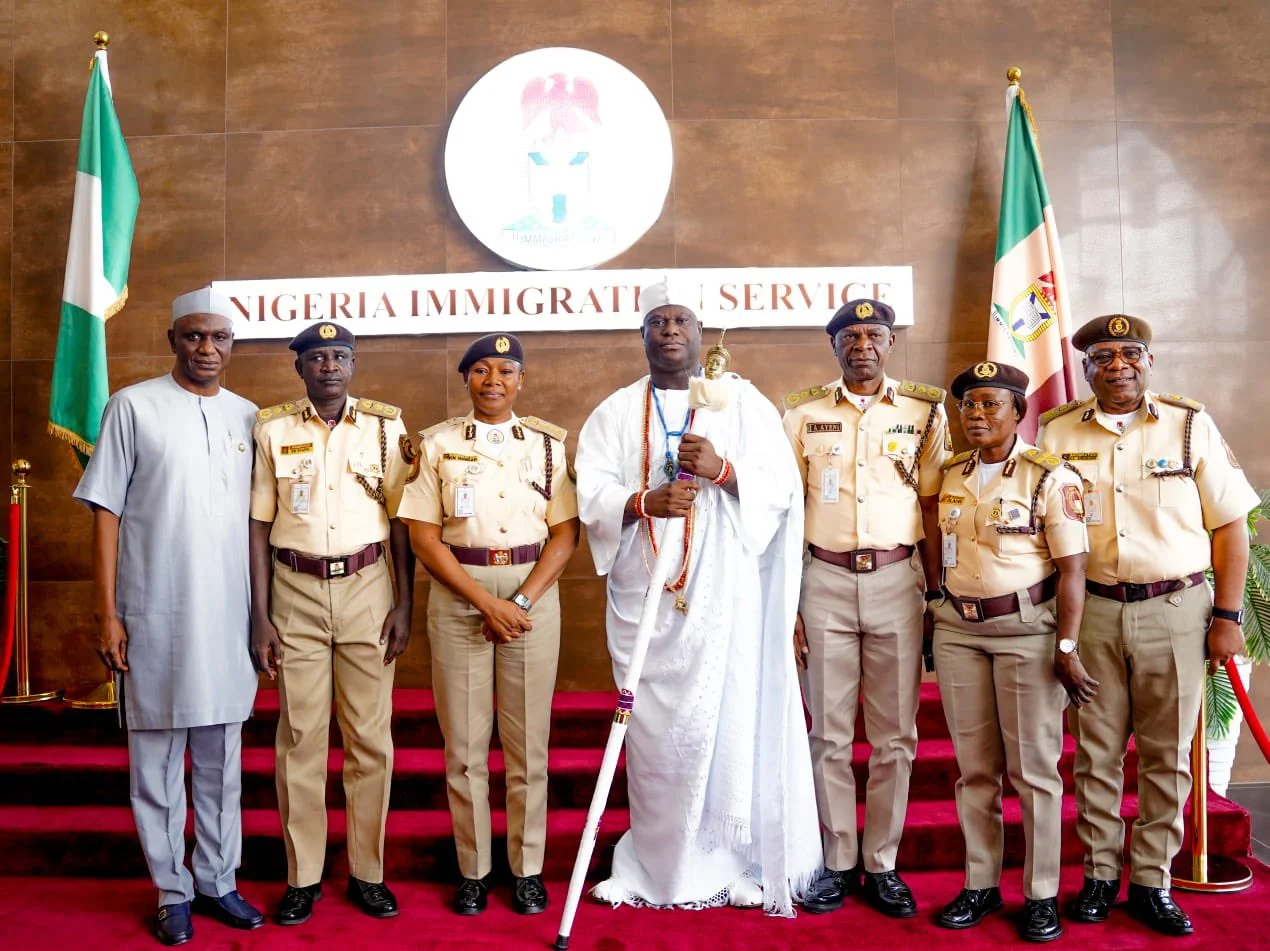
The Ooni of Ife, Oba Adeyeye Enitan Ogunwusi Ojaja II, has renewed his diplomatic passport at the headquarters of the Nigeria Immigration Service in Abuja, using the occasion to applaud the sweeping reforms currently underway in the nation’s immigration architecture.
The first-class monarch was received at the NIS headquarters by the Comptroller-General of Immigration, Kemi Nandap, and top members of the service’s management team. His visit, though administrative in purpose, quickly evolved into a symbolic endorsement of the Federal Government’s ongoing efforts to modernise and professionalise Nigeria’s immigration system.
According to a statement issued by the Service Public Relations Officer, Akinsola Akinlabi, the Ooni’s presence at the headquarters underscored the growing engagement between traditional institutions and federal agencies in matters of governance, security and national identity. The NIS described the monarch as a “revered royal father” whose visit carried both cultural and institutional significance.
During the visit, the Ooni commended President Bola Ahmed Tinubu, the Minister of Interior, Olubunmi Tunji-Ojo, and the leadership of the Nigeria Immigration Service for what he described as transformative policies being implemented under the Renewed Hope Agenda. He particularly highlighted reforms aimed at strengthening migration management, tightening border governance and improving service delivery to Nigerians at home and abroad.
The monarch’s remarks align with a broader narrative emerging from the Ministry of Interior and the NIS, which have in recent months publicised a series of changes designed to overhaul the way Nigerians access passport and immigration services. These reforms include the digitalisation of key processes, the introduction of stricter security protocols at borders and the restructuring of internal systems to reduce delays, corruption and bureaucratic bottlenecks.
Officials say that one of the most visible aspects of the reform drive has been the push to digitalise passport application and renewal procedures. The NIS has been working to expand online platforms, streamline biometric data capture and reduce the need for multiple physical visits to immigration offices. The goal, according to the service, is to make passport acquisition more predictable, transparent and user-friendly, while also enhancing the integrity of Nigerian travel documents.
Border surveillance has also been a central focus. Under the supervision of the Ministry of Interior, the NIS has been rolling out enhanced monitoring systems at land, air and sea entry points. These measures are intended to curb irregular migration, human trafficking, smuggling and cross-border criminality, while facilitating legitimate travel and trade. The service has repeatedly stressed that effective border governance is not only a security imperative but also a key component of economic development and regional integration.
Migration management processes are being restructured to align with international best practices. This includes better data collection and analysis, improved coordination with other security and law enforcement agencies and closer collaboration with international partners. By modernising its systems, the NIS aims to position Nigeria as a more reliable player in global mobility frameworks, from visa regimes to labour migration agreements.
The Ooni’s commendation, as captured in the NIS statement, was framed as a reflection of the wider recognition that these reforms are beginning to gain among influential stakeholders. Traditional rulers in Nigeria often serve as bridges between government institutions and local communities, and their public endorsements can help build trust in official policies. In this context, the Ooni’s praise for the immigration reforms carries both symbolic weight and practical implications for public perception.
Beyond the technical aspects of passport renewal, the monarch’s visit also highlighted the role of diplomatic passports in Nigeria’s foreign relations and cultural diplomacy. As one of the country’s most prominent traditional rulers, the Ooni frequently travels abroad for cultural, religious and diplomatic engagements. A valid diplomatic passport not only facilitates his movement but also underscores the recognition of his office within Nigeria’s official protocol system.
Diplomatic passports are typically reserved for top government officials, senior diplomats and certain categories of high-ranking traditional rulers whose roles extend beyond local administration to representational functions at the national and international levels. The renewal of such a document at the NIS headquarters, rather than through intermediaries, also served as a public demonstration of confidence in the service’s processes.
Within the NIS, the visit was seen as an opportunity to showcase the agency’s evolving capacity and to reinforce its image as a modern, citizen-focused institution. Under Comptroller-General Kemi Nandap’s leadership, the service has repeatedly emphasised professionalism, accountability and technological innovation as guiding principles. Hosting a high-profile traditional ruler at the headquarters allowed the management team to present these priorities directly to a figure whose influence cuts across political, cultural and generational lines.
The Ooni’s remarks dovetail with the Tinubu administration’s broader Renewed Hope Agenda, which has framed institutional reform as a cornerstone of national renewal. In the immigration sector, this has translated into efforts to clear passport backlogs, reduce processing times, improve staff welfare and tighten oversight mechanisms. While challenges remain, particularly in terms of infrastructure gaps and public complaints about delays in some locations, officials insist that measurable progress is being recorded.
Observers note that the intersection of traditional authority and state institutions, as exemplified by the Ooni’s visit, is an enduring feature of Nigeria’s governance landscape. Traditional rulers, though without formal legislative or executive powers, wield considerable moral and social influence. Their support can lend legitimacy to government initiatives, while their criticism can amplify public dissatisfaction.
By publicly aligning himself with the immigration reforms, the Ooni has effectively signalled to his subjects and to Nigerians more broadly that the changes underway at the NIS deserve attention and, potentially, patience. His emphasis on migration management and border governance also reflects growing awareness within traditional institutions of the complex challenges posed by global mobility, from youth emigration to security threats.
For the Nigeria Immigration Service, the visit and the accompanying commendation serve as both validation and motivation. As the agency continues to push digitalisation, enhance border surveillance and refine its internal processes, it faces the dual task of meeting rising public expectations and sustaining political support. Endorsements from respected figures such as the Ooni of Ife may help to bolster morale within the service and encourage continued investment in its modernisation agenda.
In the end, what began as a routine administrative exercise – the renewal of a diplomatic passport – became a platform for a broader conversation about reform, security and service delivery. It underscored how seemingly technical processes within a government agency can carry wider implications for national image, citizen experience and the delicate balance between tradition and modern statecraft in Nigeria.

.jpeg?alt=media&token=96b327a5-8e62-4ed1-a078-308aff149ed1)