You know that character in every American high school movie?
The tall one.
Over 6 feet.
Basketball captain.
Walks into the hallway and suddenly the air changes.
The lockers seem to shine more.
The wind machine turns on for no reason.
Time slows down.
The popular girls that are icy to everyone? They melt because of his presence.
Even the teachers look up to see the energy shifter.
Yeah… that’s “Parker.”
Now imagine that same energy but no, no, no… not human.
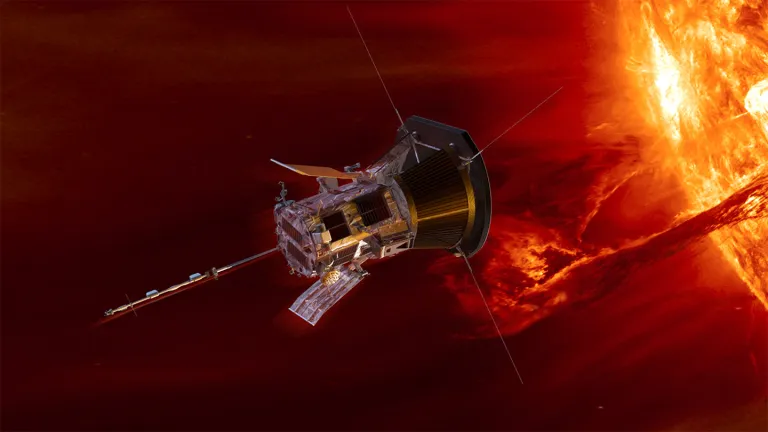
The Parker Solar Probe.
When it entered the Sun’s neighborhood, it didn’t just pass by quietly. It broke records.
Launched by NASA in 2018, this spacecraft has one mission: get closer to the Sun than anything ever built. Not orbit politely from a distance. Not wave from afar. Get close.
And in December 2024, it did.
It flew just about 6.1 million kilometers from the Sun’s surface. I guess “Parker” really wants to be hotter than he is. That was closer than any human-made object in history. While doing that, it reached nearly 700,000 km per hour making it the fastest object humans have ever created.
That’s not normal behavior.
I see the main-character energy.
But here’s the twist unlike the high school Parker, this one isn’t admired for looks or popularity. It’s admired for survival.
The Sun’s outer atmosphere, the corona is millions of degrees hot. Radiation is intense. Conditions are extreme. Solar particles move violently. Magnetic fields twist and snap. This is not a friendly environment. This is literal fire, the kind no human could stand near.
And yet, protected by a powerful carbon-composite heat shield called the Thermal Protection System, Parker survived the flyby and sent a signal back to Earth.
That signal was like the hallway scene when everyone realizes:
“Oh. He really is him.”
Except in this case, “him” is a spacecraft that went into literal fire singing “this guy is on fire” and came back with data.
And the data matters.
Because Parker is helping scientists understand:
Why the corona is hotter than the Sun’s surface?
How solar wind forms and accelerates?
How solar storms affect satellites, GPS systems?, communication networks, and even electricity on Earth
It’s not just flexing near the Sun for vibes. It’s solving a mystery that has confused scientists for decades.
So yes, let’s cheer Parker like he just won a basketball game they were about to lose.
He’s a probe that survived extreme temperatures, broke speed records, rewrote space history, and casually touched the Sun like it was just another school hallway.
Now what is that called?
That is legendary behavior.
7